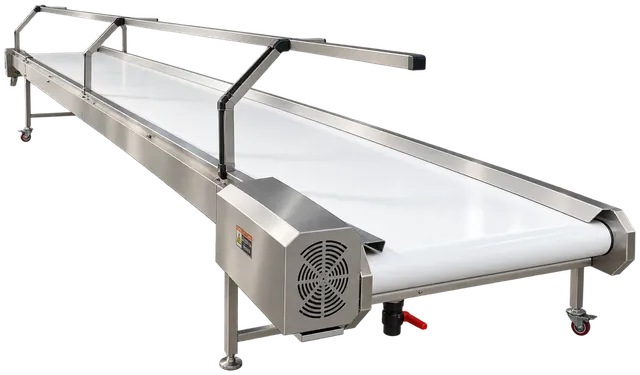
Flat Belt Conveyor
Carries product horizontally between two stations of the line on a food-grade belt. Used for transfer, as a working table along the belt and in front of packing.
- AISI 304 stainless steel
- Horizontal transfer on a food-grade belt
Stainless belt conveyors that link the machines of a food line: horizontal transfer, inclined feeding, Z-type lifting and positive-drive belts. Length, width and height are made to the line.
Carries product horizontally between two stations of the line on a food-grade belt. Used for transfer, as a working table along the belt and in front of packing.
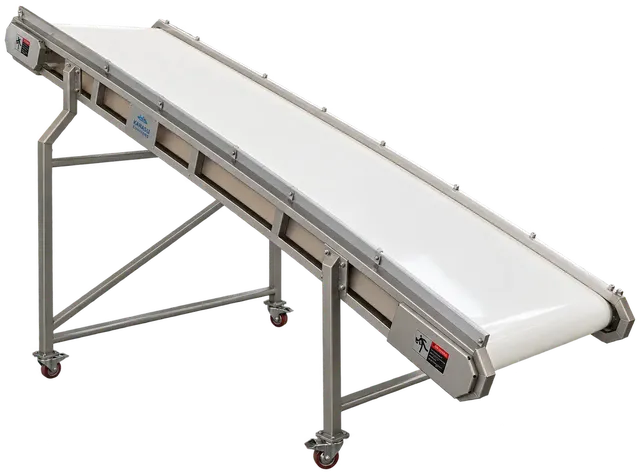
Lifts product from a low loading point to the inlet of the next machine, for example a vibrating screen, washer or packing machine.
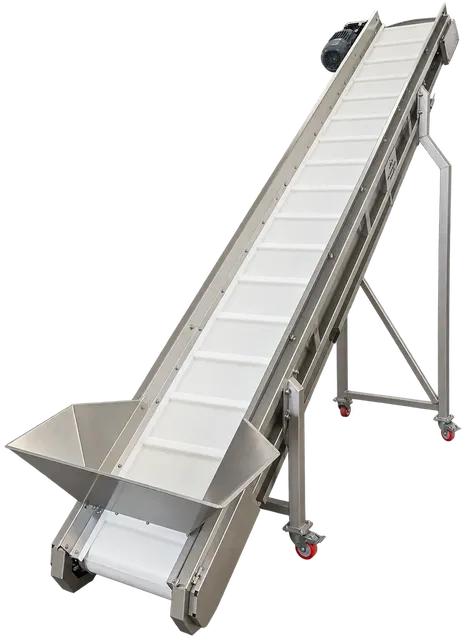
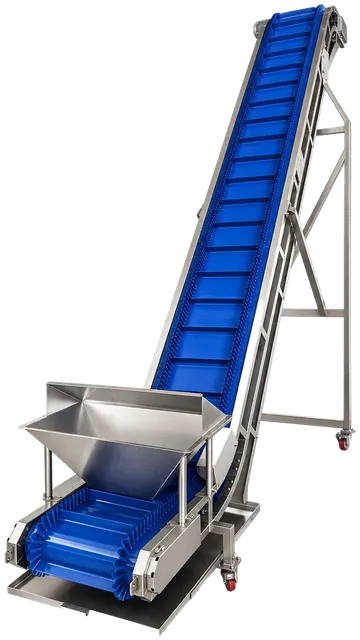
Carries raw or processed product from one point of the line to the next. Cleats on the PVC belt hold the product on the incline; the wide hopper takes product emptied in batches.
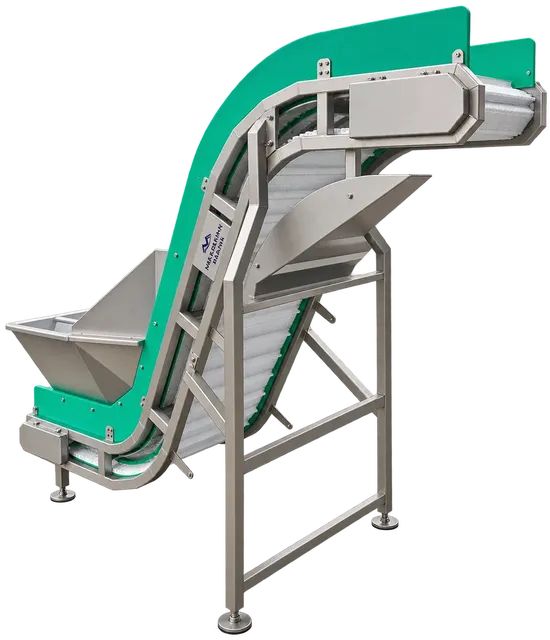
Lifts product to steep or high points that a PVC belt cannot reach. The Z form gives a horizontal loading section, a steep rise and a horizontal discharge section.
Carries product up an incline on a positive-drive belt in a controlled way. Sprockets drive the belt through profiles on its underside, so the movement does not rely on drum friction alone.
A belt conveyor links the machines of a line. It takes product from a loading point, a washer or a screen and delivers it to the next machine at a steady rate and at the right height. The frame, the belt and the drive are chosen for the product, the distance and the height difference.
| Conveyor | Use | Belt |
|---|---|---|
| Flat belt conveyor | Horizontal transfer, working table, in front of packing | Food-grade PVC / PU |
| Inclined belt conveyor | Lifting at a moderate angle to the next machine | Food-grade PVC / PU |
| Cleated incline conveyor | Feeding from a hopper at steeper angles | PVC with cleats |
| Z-type modular conveyor | High inlet points, wet product after washing | Perforated modular belt |
| Positive-drive cleated conveyor | Inclined transfer where belt slip must be avoided | Positive-drive belt, cleats and side walls |
PVC and PU belts are the usual choice for dry and semi-dry product such as dried fruit, nuts and pulses. The surface is closed, smooth and easy to wipe down. Cleats and side walls can be added for inclines.
Perforated modular belts are made of plastic modules joined by rods. Water drains through the belt, so they suit product coming straight from a washer. They resist high temperature and single modules can be replaced.
Positive-drive belts are one-piece belts with profiles on the underside. Sprockets engage the profiles, so the belt does not depend on drum friction to move. There are no module hinges or rods where residue can collect.
A plain belt carries product up a gentle slope. Above that, product starts to roll or slide back, and the belt needs cleats. Cleat height and spacing follow the piece size and the capacity: larger pieces need higher cleats, a higher capacity needs closer spacing or a wider belt. Side walls keep small pieces from falling off the edges on the rise.
Where the inlet of the next machine is high and floor space is short, a Z-type conveyor gives a horizontal loading section, a steep rise and a horizontal discharge section in one machine.
A conveyor moves the product as it is. Where the product must also be spread, separated into single pieces or drained, a vibratory conveyor is used for that stretch instead.
Frames are AISI 304 stainless steel, built from box profile. Product contact parts are stainless or food-grade belt material. Drive is a geared motor; belt speed is set to the product and can be adjusted with a frequency inverter. Length, width, loading height and discharge height are made to the installation. The conveyor runs stand-alone or under the line PLC.
We will reply by email.