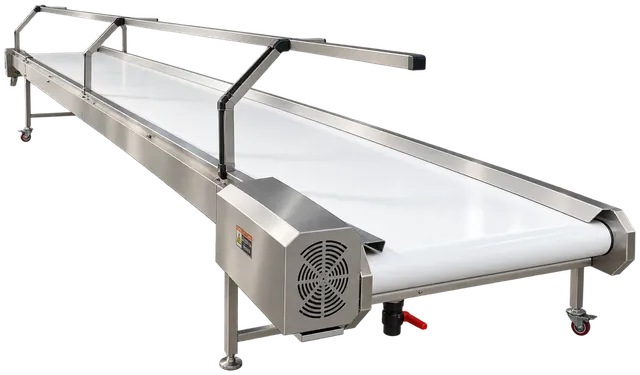
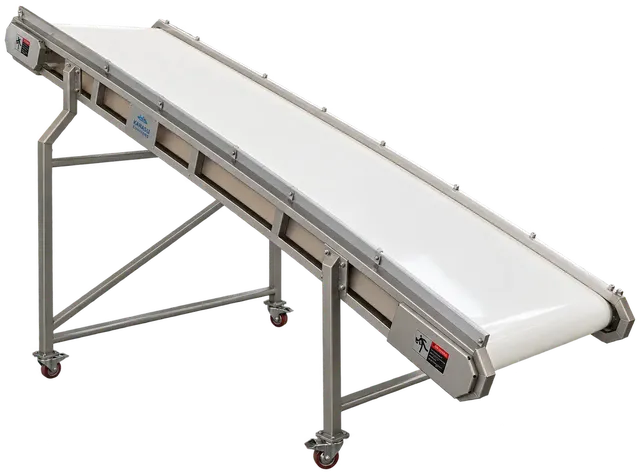
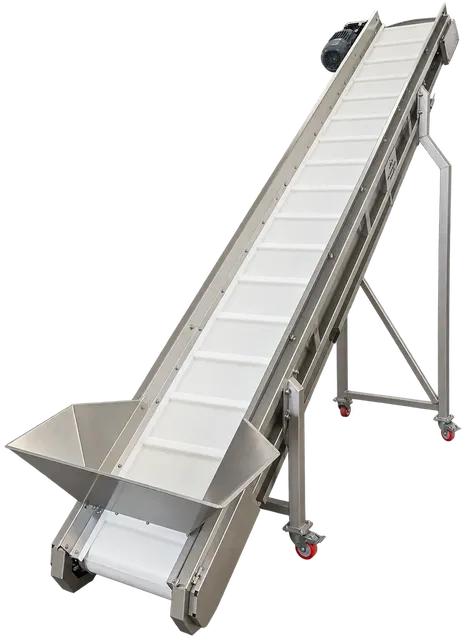
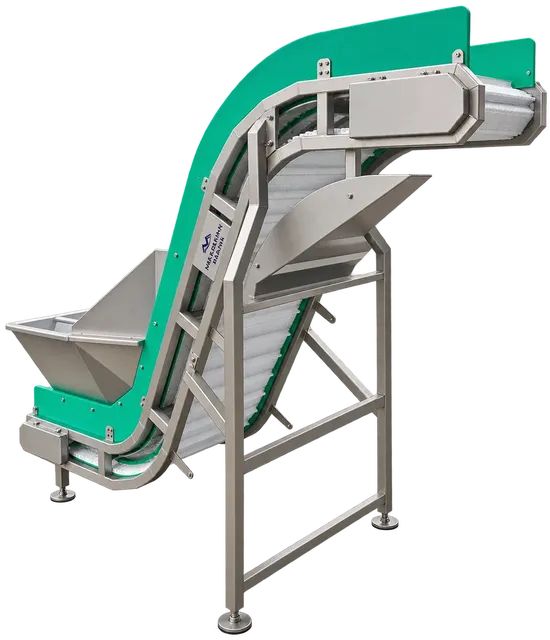
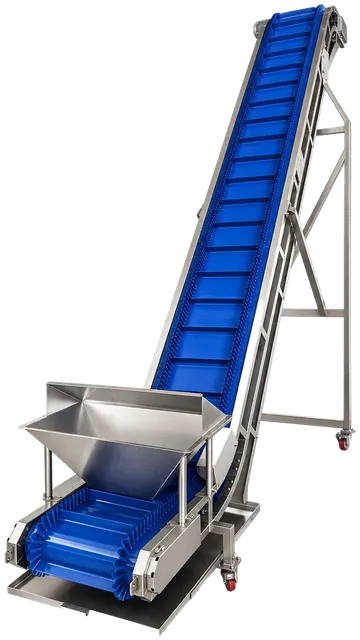
Stainless steel is chosen for the frame and the product-contact parts. The grade and the way the frame is built decide how well the conveyor survives washing.
In a food plant the frame of a conveyor is washed, wetted and wiped far more often than the frame of a conveyor in a warehouse. That is the reason stainless steel is used for the frame and for the surfaces that touch the product.
The notes below cover the two grades in common use, the conveyor types that are built in stainless steel and the design points that matter as much as the metal.
What counts as a stainless steel conveyor
A stainless steel conveyor is a conveyor system whose carrying frame, or the metal surfaces that touch the product, are made of stainless steel.
Depending on the application, these machines can work with a PVC belt, a PU belt, a modular belt or a roller conveying mechanism.
Stainless steel conveyors are preferred in damp environments, on lines that are cleaned regularly and in food processing plants.
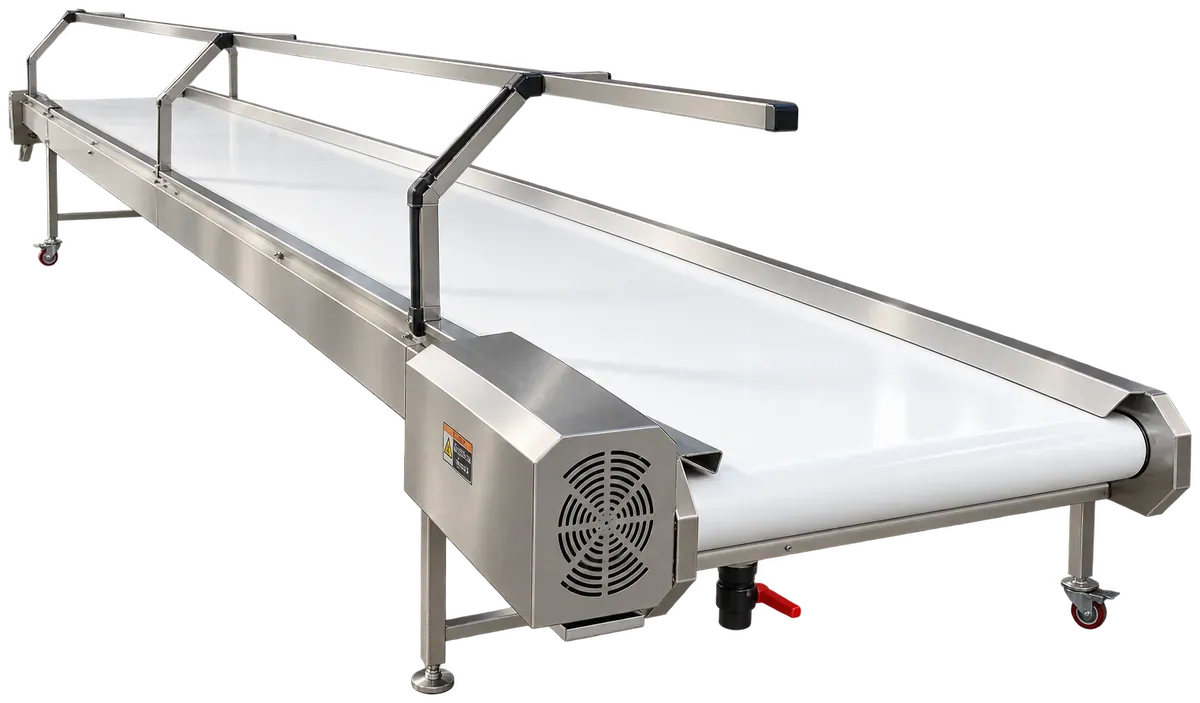
AISI 304
AISI 304 stainless steel is among the materials commonly used in food processing equipment.
It is preferred in conveyor manufacture because of its corrosion resistance and formability, and because suitable surface finishing makes cleanable structures possible.
Uses of conveyors with an AISI 304 frame include dried-fruit processing, vegetable and fruit sorting, packing and product transfer lines.
The suitability of the material still depends on the environment. In processes with a high chloride content or aggressive chemicals, other material options may be needed.
AISI 316
In certain corrosive environments AISI 316 stainless steel can give higher corrosion resistance than AISI 304.
It may be preferred in environments that contain chlorides and in some chemical processes.
Using AISI 316 is, however, not required in every application.
The material should be chosen by considering the process liquid, the cleaning chemicals, the temperature and the working environment together.
Stainless conveyor types
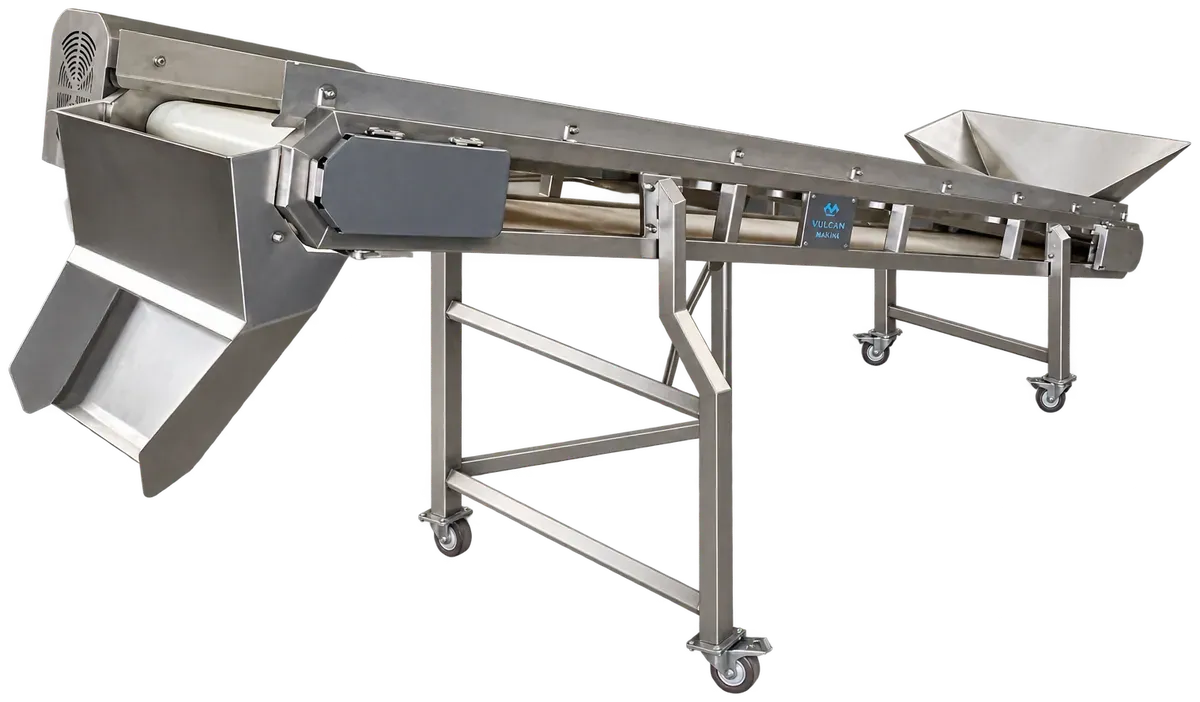
Stainless steel belt conveyor
A stainless steel belt conveyor is a system in which a stainless steel carrying frame is used with a suitable belt.
It passes product between the different production stations of a food processing line.
The belt width, working height and conveying speed can be set for the production line.
Stainless steel modular conveyor
Modular conveyor systems work by linked plastic belt modules moving over a stainless steel frame.
They can be used in washing, draining and inclined conveying.
The surface of the modular belt must be chosen for the size of the product to be carried.
Stainless steel Z-type conveyor
Z-type conveyors are used to transfer product between production machines that sit at different heights.
With a suitable design, the stainless steel frame and modular belt can be integrated into food processing lines.
In the design, the tendency of the product to slide, the angle of incline, the conveying capacity and the available space are considered.
Stainless steel roller conveyor
Stainless steel roller conveyor systems can be used for cartons, crates and packaged products.
They transfer product between packing machines, box filling stations and dispatch areas.
Where stainless conveyors are used in food
It is important that the equipment used in food production can be cleaned.
When designed properly, stainless steel conveyors can support hygienic production processes.
They are preferred especially in the following applications:
Dried-fruit processing: moving raisins, apricots, figs, dates, plums and dried tomatoes between the cleaning, sorting and packing stages.
Fruit and vegetable processing: transfer after washing, sorting and grading.
Nut processing: product feeding, conveying and packing stages.
Bakery products: moving products between production stations with a suitable belt.
Packaging: passing packaged product to boxing and dispatch stations.
Hygienic design points
A hygienic conveyor design is more than using stainless steel.
Across the whole system, the dead spots that make cleaning difficult should be reduced, and surface quality, water drainage and access for maintenance should be considered.
Whether belts that touch the product directly are suitable for food contact must also be confirmed separately.
Product residue that collects under the conveyor, roller areas that are hard to clean and connections that cannot be reached can be a hygiene risk.
For this reason the mechanical design and the process conditions have to be considered together in the manufacture of a stainless steel conveyor.
In practice
Feed conveyors with an AISI 304 frame, modular conveyors and inspection conveyors with lighting are built to order, with belt and dimensions chosen for the line. The contact page names the manufacturer referenced on this site.