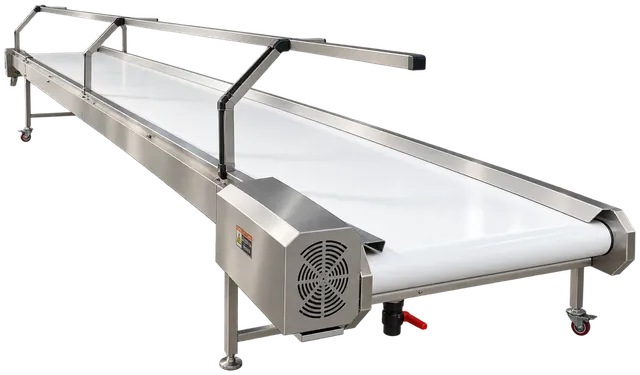
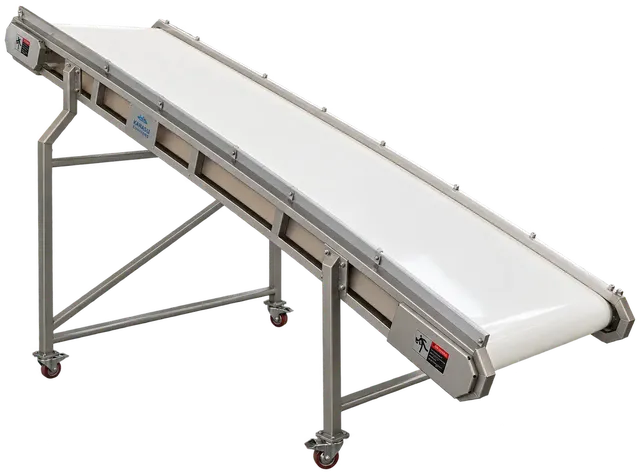
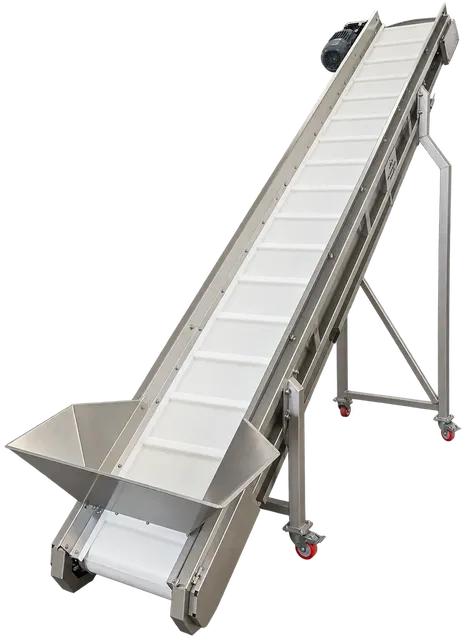
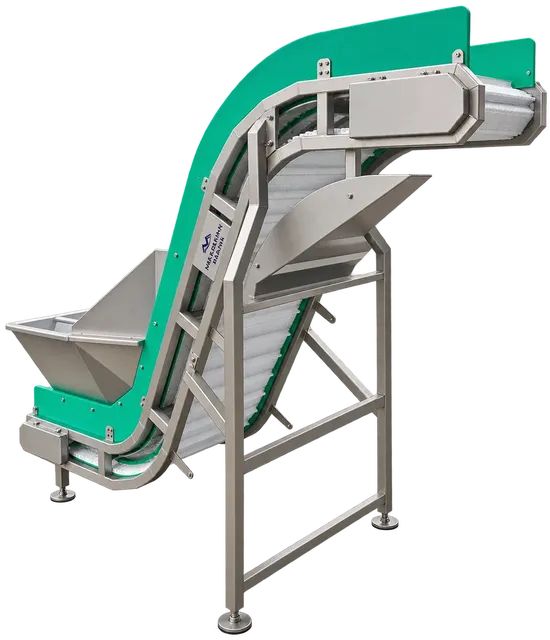
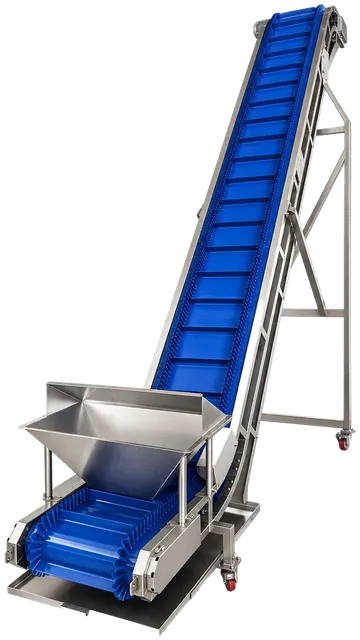
The belt is the part that touches the product. Its material sets how the conveyor is cleaned, how it wears and what it can carry.
On a belt conveyor the belt is the surface the product rides on. It carries the load, it takes the wear and, on a food line, it is the part that has to be cleaned most often. Changing the belt type therefore changes more than the look of the machine.
This page compares the five belt types that turn up most often and then looks at how the choice is made on a food line.
What the belt does
A conveyor belt is the moving carrying surface that takes product from one point to another.
In a belt conveyor, the motion produced by the electric motor and gearbox is passed to the belt through the drive mechanism.
Belt conveyor systems can be used on horizontal and inclined lines and on lines with special geometry.
The material and surface of the belt have to be chosen to suit the physical form of the product and the process conditions.
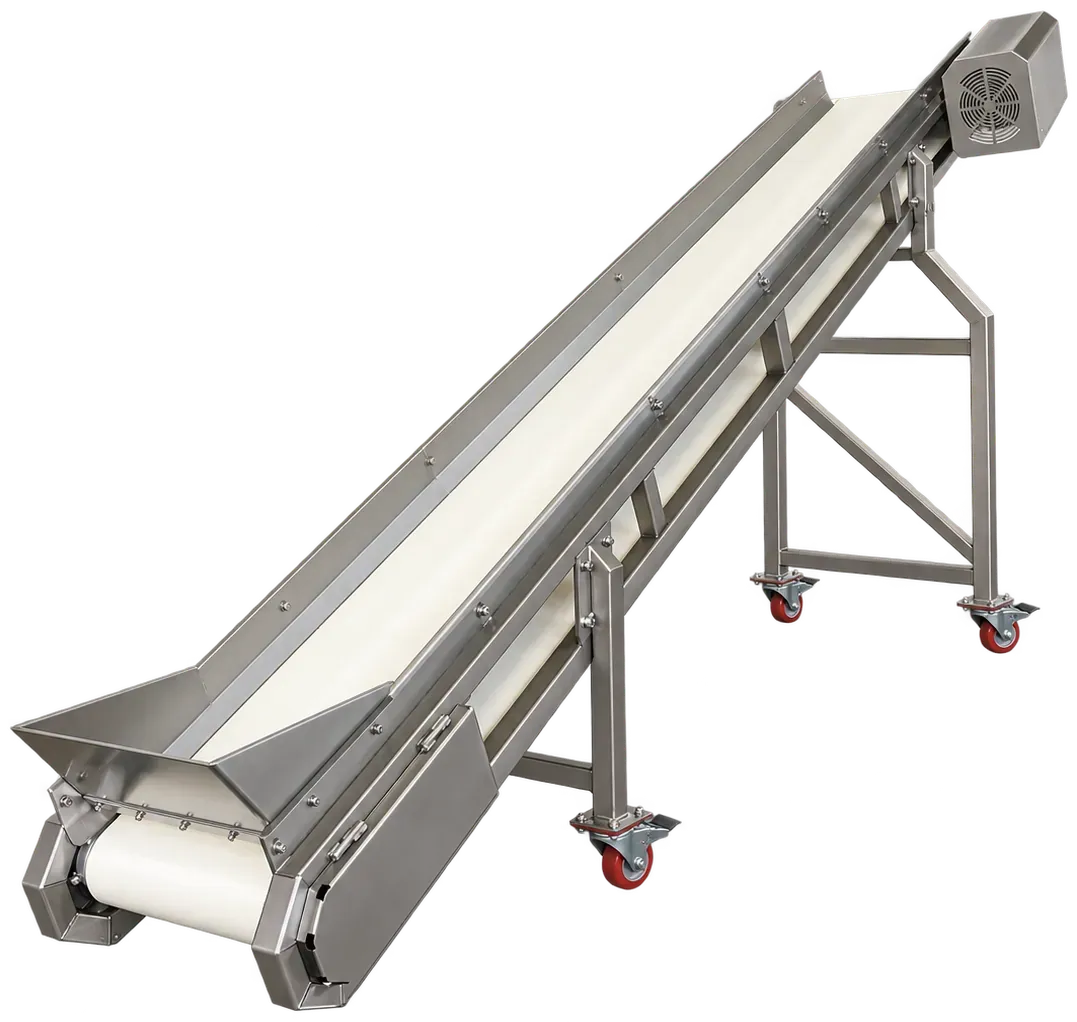
The five belt types
PVC conveyor belt
PVC conveyor belts are available with different surface patterns and thicknesses.
They can be used in packaging, light industry and suitable food processing applications.
Some advantages of PVC belts are:
- different surface options
- adaptable to various conveyor sizes
- usable for both flat and inclined conveying
- an economical solution in certain applications
Whether a PVC belt is suitable for direct food contact has to be confirmed from the technical and conformity documents of the belt in use.
PU conveyor belt
Polyurethane conveyor belts are among the belt options preferred in food processing.
In suitable grades and formulations they can resist oils, abrasion and various process conditions.
PU belts can be used in systems that carry dried fruit, vegetables, bakery products and other foods.
When choosing the belt, the working temperature, the moisture content of the product and the cleaning chemicals in use should be taken into account.
Modular conveyor belt
Modular conveyor belts are made of plastic modules that are linked together.
The belt surface can be flat, perforated or made with a special carrying profile, depending on the application.
Modular belts can help in product washing, water drainage and inclined conveying.
Being able to replace a damaged module can make maintenance easier in some applications.
The module connections and hinge areas should, however, be considered carefully in the cleaning plan.
Rubber conveyor belt
Rubber conveyor belts are durable belts used in a range of industrial conveying applications.
Different rubber belt constructions can be chosen according to the weight of the material, its abrasiveness and the working environment.
Rubber belt systems are common in mining, recycling and some heavy industry applications.
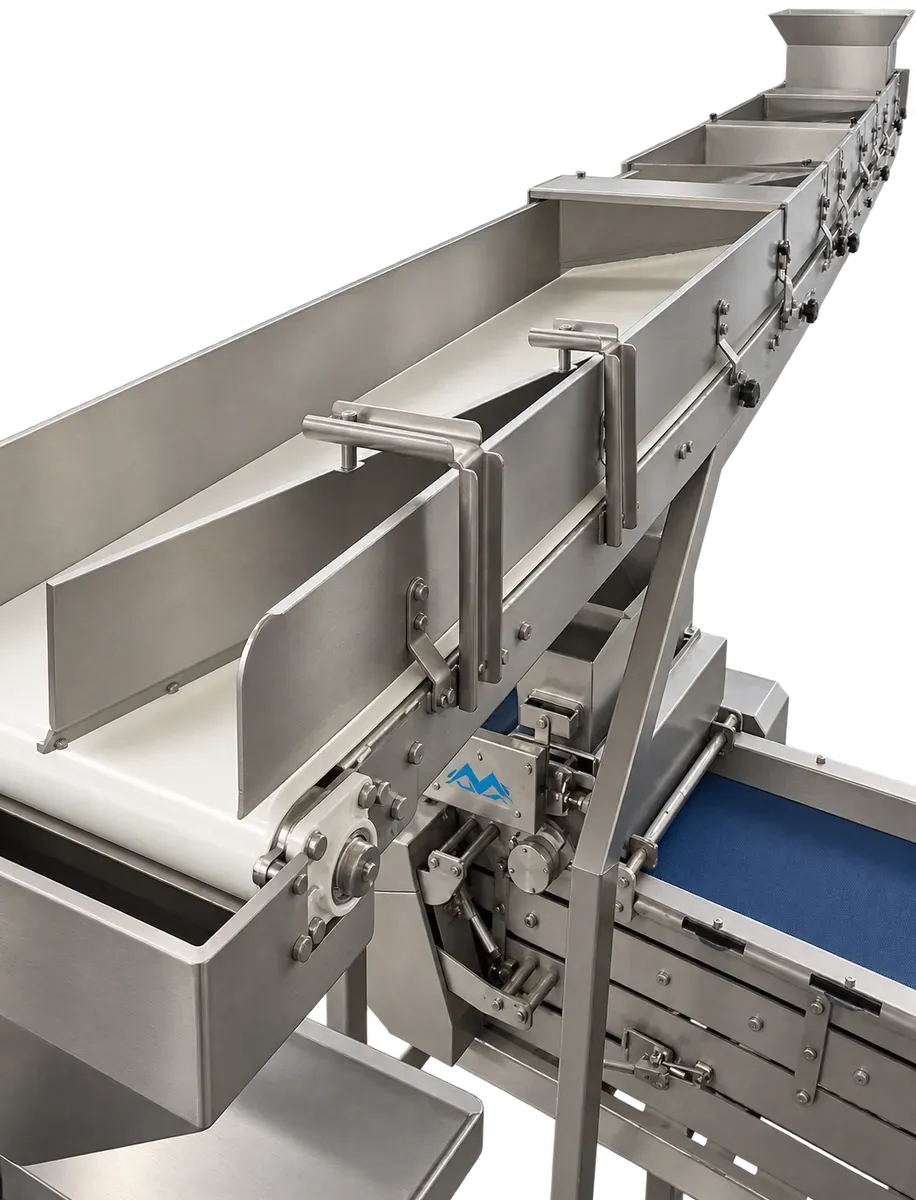
Wire mesh belt conveyor
A wire mesh belt conveyor uses a woven metal or wire carrying belt.
The open belt structure allows air and liquid to pass through.
For this reason it is used in certain drying, cooling, heat treatment and product transfer applications.
The material, carrying capacity and working temperature of the wire belt have to be chosen to suit the process.
Belts on food lines
In food plants the belt is chosen according to the product.
On dried fruit and vegetable processing lines, PVC, PU or modular belt systems can be used.
Where surface water has to be removed after washing, modular belts with a suitable opening geometry can help.
For packaged food, flat belt or roller systems can be preferred.
Belts that touch food directly must have food-contact documents that match their conditions of use.
The frame under the belt
In food production the material of the conveyor frame matters as well as the belt.
AISI 304 stainless steel is one of the frame materials used in many food processing applications.
In the design of stainless steel conveyors, access for cleaning, connection points, surface quality and water drainage should be considered.
In damp production areas and on lines that are washed regularly, a correct frame design can make the equipment easier to maintain.
A checklist for choosing a belt
The following technical information should be evaluated to decide on the right belt:
- type and dimensions of the product
- hourly production capacity
- belt width and conveying length
- product temperature and moisture content
- whether there is direct contact with food
- angle of incline of the conveyor
- cleaning and maintenance conditions
- running time
- ambient conditions
For example, with small granular products the openings of a modular belt can lead to product loss, so the belt surface has to be chosen with care.
On inclined conveying systems, cleated belts or belts with a suitable surface profile can be considered to stop the product from sliding back.
In practice
A belt conveyor for a given line is designed from the capacity of the line and the properties of the product. Feed conveyors, Z-type modular conveyors and inspection conveyors with lighting can all be fitted into the same process. The contact page names the manufacturer referenced on this site.