A food plant rarely uses a single conveyor. A line is usually a sequence of different types, each chosen for one stretch of the process.
A food plant rarely runs on one kind of conveyor. A raw-material intake, a washing stage, a sorting table and a packing machine each ask something different of the conveyor that serves them, so a line is usually built from several types in sequence.
This page goes through the types in common use, then the belts, hygiene, drives and the questions to settle before a conveyor is ordered. For the basics, see what a conveyor is.
Conveyors in a food plant
A conveyor is a mechanical system that moves products or raw materials from one point to another continuously or in a controlled way.
In the food sector, conveyors can be used for many purposes, such as:
- product feeding
- product transfer
- elevation
- horizontal conveying
- changing direction by 90 degrees
- connecting machines
- feeding a packing line
- sorting and inspection
- cooling
- drying
- transfer after washing
The biggest advantage of conveyor systems is that they make the product flow on the line continuous and controlled.
The types in use
Many different types of conveyor can be used in the food sector. The main types are:
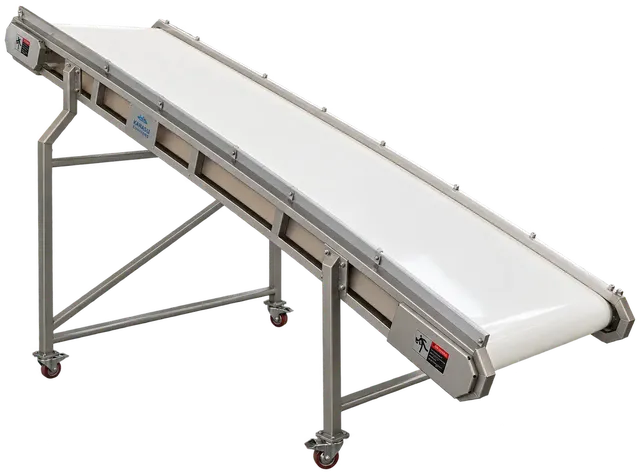
- belt conveyor
- modular belt conveyor
- Clean Drive conveyor
- Z conveyor and modular Z conveyor
- 90-degree conveyor
- elevator conveyor
- PU, PVC, rubber and wire mesh belt conveyors
- roller conveyor
- screw conveyor
- vibratory conveyor
- feed conveyor
- inspection conveyor
- return conveyor
Each system offers an advantage for a different product and process.
Stainless steel frames
On conveyors used in food production, AISI 304 stainless steel is mostly preferred in the areas that touch the product.
AISI 316 stainless steel conveyors can be used in applications such as more aggressive washing, or salty or acidic products.
The advantages of stainless steel conveyors can be listed as hygienic structure, corrosion resistance, easy cleaning, long service life, suitability for food production environments and resistance to washing.
Stainless steel on its own is not enough, though. The conveyor must also be easy to clean, must reduce product build-up and must follow hygienic design principles. See stainless steel conveyor systems.
Clean Drive conveyors
A Clean Drive conveyor is one of the belt systems developed for hygienic conveying, especially in the food sector.
The most important feature of Clean Drive systems is that the belt and the drive system work in a more hygienic and controlled way.
On this type of conveyor, advantages such as these can be obtained:
- ease of cleaning
- less belt slip
- a more controlled drive
- less product build-up
- a hygienic structure
- suitability for frequent washing
Clean Drive conveyors can be preferred for dried fruit, meat, poultry, fish, vegetables, fruit, packaged food, washing lines and wet processes.
Where Clean Drive is used
Clean Drive belt systems are an advantage especially in food plants that are washed often.
The main areas of use include raisin processing lines, dried apricot washing lines, date processing lines, meat processing plants, poultry factories, seafood plants, vegetable washing lines, fruit processing lines and transfer lines before packing.
In the design of a Clean Drive conveyor, the belt, the drum or drive geometry and the tensioning system have to be chosen correctly.
Modular belt conveyor
A modular belt conveyor works with a belt system built by linking plastic modules together.
The main advantages of these systems are:
- easy maintenance
- easy replacement of parts
- different width options
- straight, inclined and curved designs
- a washable structure
- different surface options
- modular belt alternatives suited to the food sector
Modular belt conveyors offer strong solutions especially for product guiding and multi-directional line designs.
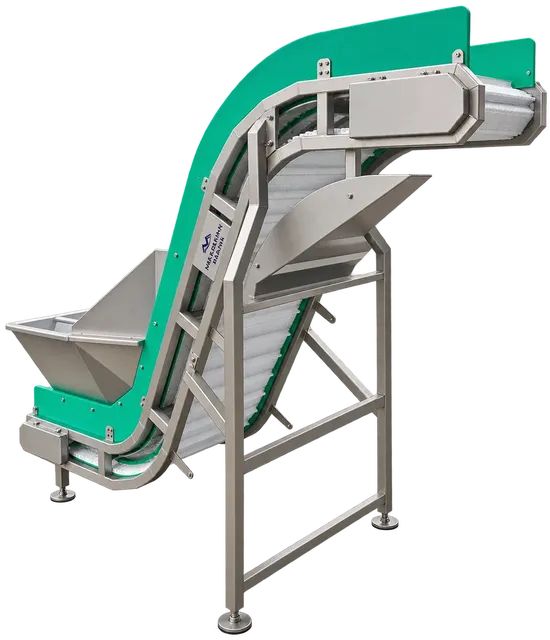
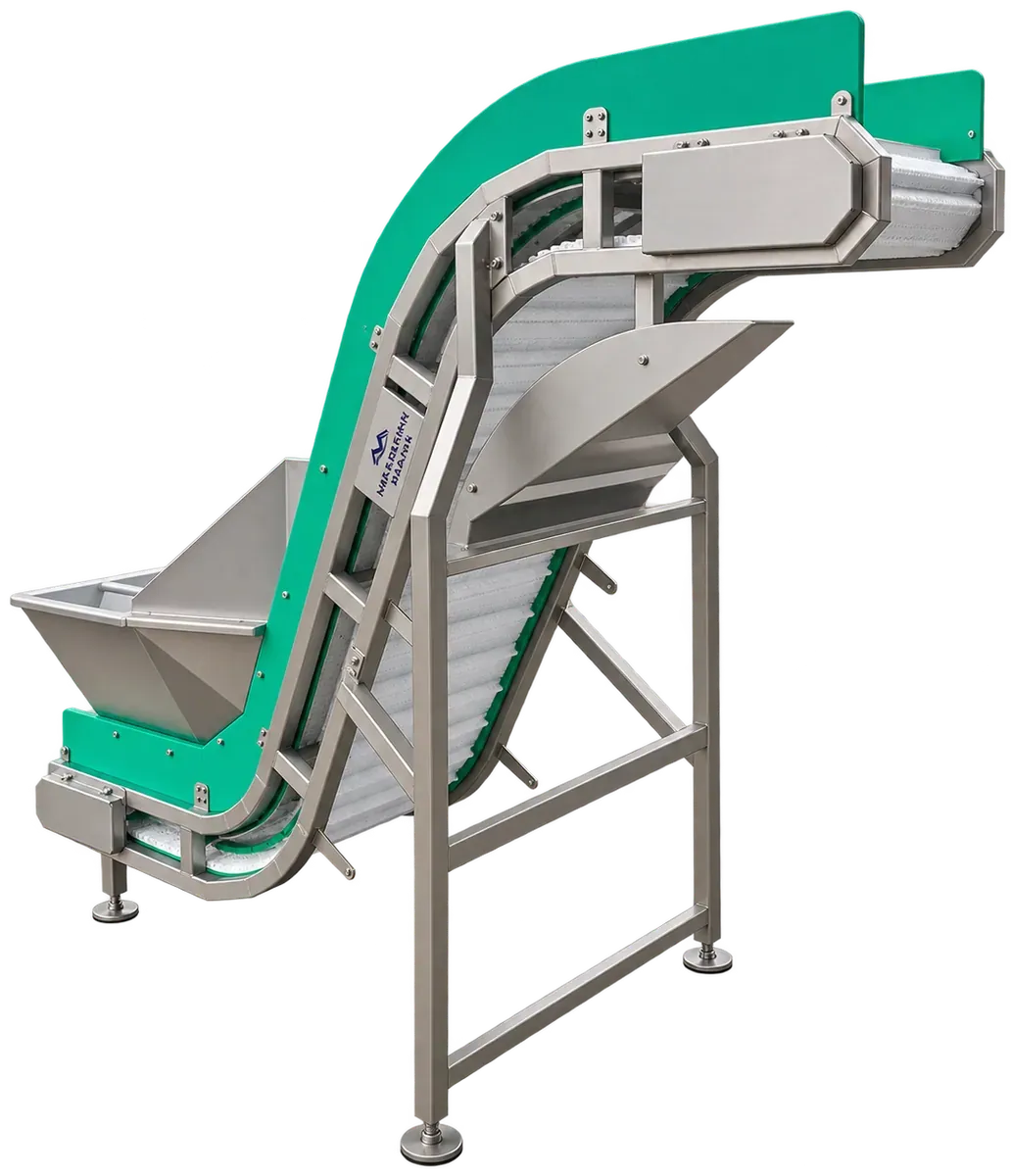
Modular Z conveyors
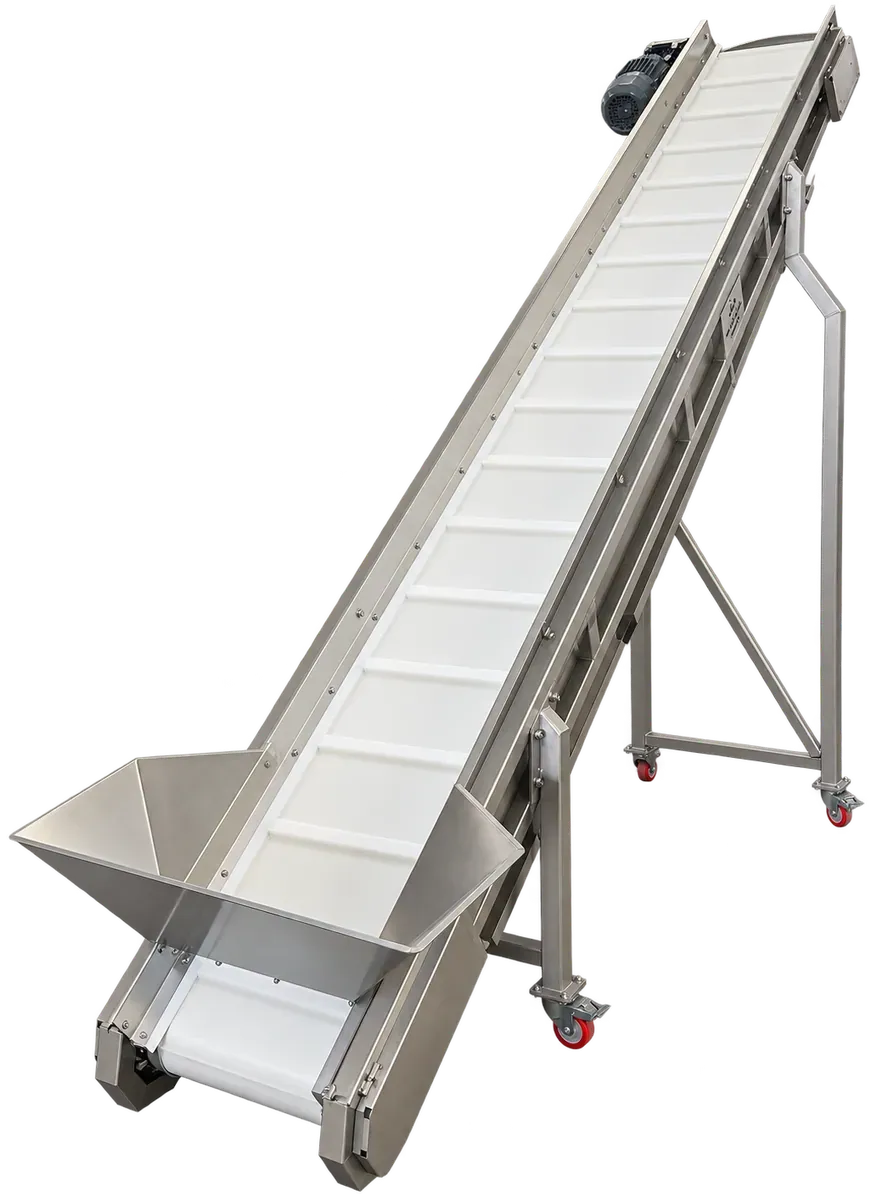
A modular Z conveyor takes the product from a low level, carries it up and gives a horizontal outlet again.
Because of the Z design, the system consists of three basic sections:
- a lower horizontal section
- an inclined rising section
- an upper horizontal section
This structure is used especially to take product from one machine and pass it to another machine at a higher level.
Where modular Z conveyors are used
Modular Z conveyors can be used in applications such as feeding packing machines, feeding an optical sorter, feeding a grading machine, elevation on a packing line, carrying product to storage hoppers and carrying between floors of a production line.
The main product groups are dried fruit, nuts, pulses, grain, packaged products and small-piece food products.
Z conveyor design points
In the design of a Z conveyor, the following have to be calculated correctly:
- conveying height
- angle of incline
- belt type
- how the product slides
- cleat or flight size
- capacity
- inlet height
- outlet height
- motor power
- gearbox ratio
A wrong angle or a wrong belt can make the product slide back and cause a loss of capacity.
90-degree conveyors
A 90-degree conveyor is a conveyor system used to change the direction of product flow by 90 degrees.
It is preferred in plants with limited floor area, to turn the lines and use the space efficiently.
The 90-degree turn can be made in different ways, such as a modular belt, a curved belt system, a roller system, a transfer mechanism or a chain transfer.
The main types of 90-degree conveyor that can be used in the food sector are:
Modular 90-degree conveyor: turns the product flow smoothly by 90 degrees using a modular plastic belt. It can be used for packaged or open products.
Roller 90-degree conveyor: used for cartons, crates, boxes and packaged products. It is effective especially on packing lines.
90-degree transfer conveyor: passes the product from one conveyor to another at a right angle. These systems are used especially for transferring cartons and boxes.
The main areas of use are packing lines, carton transfer systems, storage lines, turns on production lines, machine outlets, plants with limited space and automation systems.
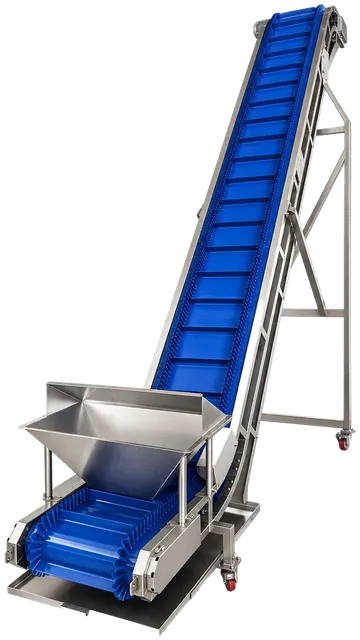
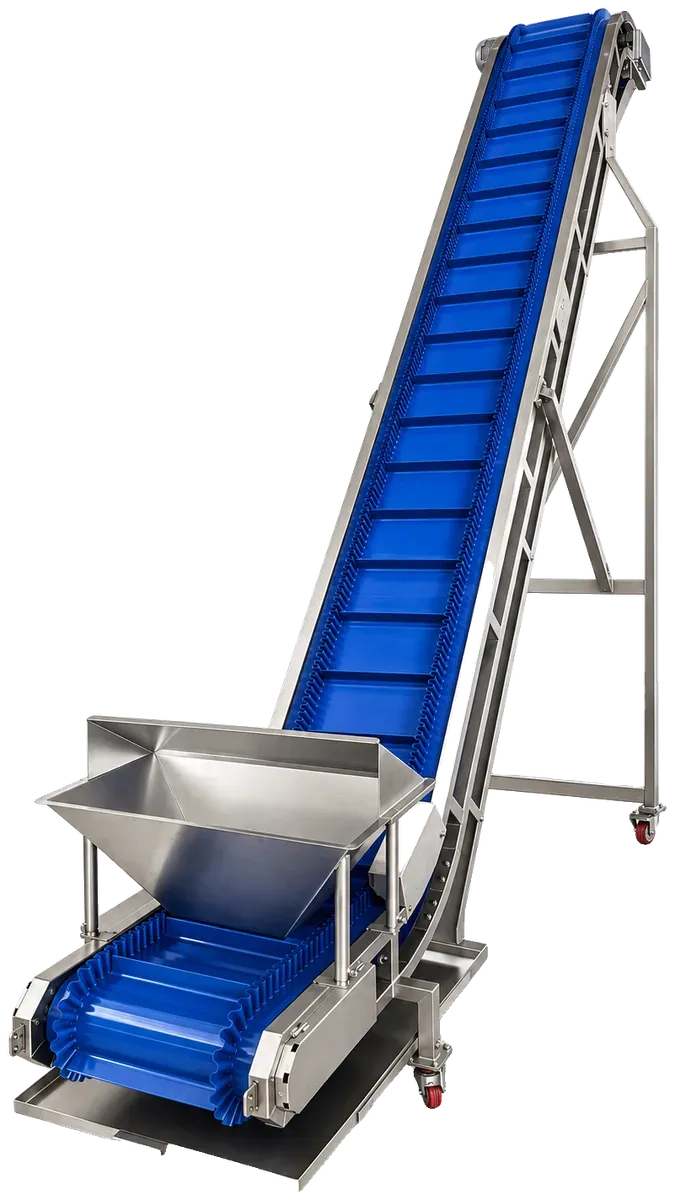
Elevator conveyors
An elevator conveyor is used to carry product vertically or on an incline to a higher level.
The main types are the Z elevator, the bucket elevator, the belt elevator, the modular elevator and the cleated belt elevator.
Elevator conveyors are widely used on packing lines, for feeding silos and for feeding machines.
Belt types
PU belt conveyor: made with a polyurethane belt. Its advantages include options suited to food applications, easy cleaning, low surface porosity, a flexible structure and the advantage of a smooth surface. PU belt conveyors can be used for dried fruit, dough products, vegetables, fruit, packing lines and inspection lines.
PVC belt conveyor: PVC belts are used in many industrial applications, but where there is direct contact with food, the conformity certificates of the belt type and the process conditions must be checked. They can be preferred especially for transferring packaged products.
Rubber belt conveyor: can be used in some conveying applications that need high mechanical strength and where direct food contact is not critical, for example heavy items such as crates, cartons and bags of raw material.
Wire mesh belt conveyor: made with a stainless steel wire belt. It is used on baking, cooling, drying, washing and heat treatment lines, and the high air and water permeability of the belt is an advantage in process applications.
For a fuller comparison, see conveyor belt types.
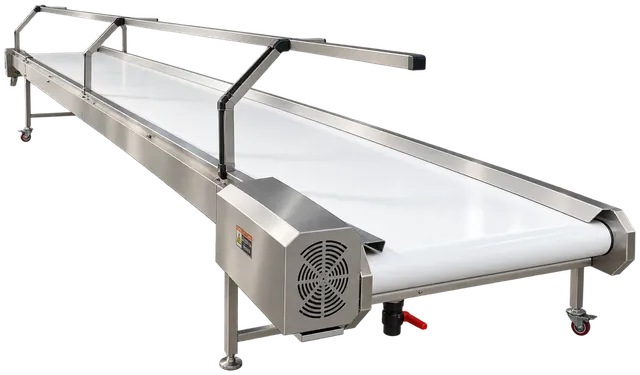
Inspection conveyors
An inspection conveyor is used for the manual checking of products and for foreign material to be picked out by workers.
It is generally designed with LED lighting and is used with products such as raisins, dried apricots, dates, dried figs, dried tomatoes and nuts.
An inspection conveyor can be used as a manual quality control solution on more economical lines that do not have an optical sorter, a laser sorter or X-ray.
Feed conveyors
A feed conveyor is used to feed product to a machine on the production line in an orderly and controlled way.
It can be used before a packing machine, a sorter, a grading machine or a washing system.
Because irregular feeding can lower the performance of a machine, the feed conveyor affects the efficiency of the whole line.
Roller conveyors
A roller conveyor is used to move packaged products such as cartons, boxes, crates and pallets.
On packing lines it can be used to transfer product between a carton sealing machine, a labelling machine, a metal detector and a palletising system.
It can be designed with motor-driven or free-running rollers.
What sets conveyor capacity
Conveyor capacity does not depend on the belt width alone.
The factors that affect capacity can be listed as:
- belt width
- belt speed
- product density
- product volume
- grain size of the product
- angle of incline
- how the product slides
- cleat size
- feed arrangement
The same conveyor can therefore give different capacities with different products.
Hygiene
In conveyors used in the food sector, hygiene is a key factor.
In a well-designed food conveyor:
- the points where product collects should be reduced
- the welds should be smooth
- the belt should be easy to clean
- there should be access under the belt
- water drainage should be considered
- the frame structure should be open and cleanable
- dead spots should be kept to a minimum
- hygienic feet and connections should be used
In plants that are washed often, Clean Drive or open-frame systems can help.
Automation
Modern conveyor systems can be controlled automatically with a PLC and sensors.
In conveyor automation, functions such as these can be applied: speed control, product detection, line synchronisation, overflow control, an emergency stop system, motor protection and communication with the packing machine.
With inverter-controlled motors, the conveyor speed can be set to the needs of the process.
Motor and gearbox
The choice of motor and gearbox has a direct effect on the performance of the conveyor.
The following have to be considered in the calculation: conveyor length, belt width, product weight, incline, speed, drum diameter and starting torque.
A wrong gearbox choice can cause excess energy consumption, belt slip, strain on the motor and mechanical failure.
Choosing the belt
The belt must be chosen according to the product. The belt types that can be used are Clean Drive, modular plastic belt, PU belt, PVC belt, wire mesh belt, rubber belt and cleated belt.
When the belt is chosen, the following should be considered: food contact, product temperature, moisture, oil content, cleaning method and angle of incline.
Questions to settle first
Before a conveyor system is chosen, the following should be settled:
- What is the product to be carried?
- What is the capacity in kg per hour or tonnes per hour?
- What is the length of the conveyor?
- What should the belt width be?
- What are the inlet and outlet heights?
- Will the conveyor be horizontal or inclined?
- Is a 90-degree turn needed?
- Is a Z conveyor needed?
- Will a Clean Drive or a modular belt be used?
- Will the machine be washed?
- Which machine will the product come from?
- Which machine will the product be passed to?
A correct system design starts from these answers.
Designing for the floor plan
Every factory has a different floor area.
Food conveyors should therefore be designed for the layout of the factory instead of being chosen from standard sizes.
Columns, doors, operator walkways, machine inlets and outlets and storage areas have to be taken into account.
On a production line, a straight conveyor, a modular Z conveyor, a 90-degree conveyor, an elevator, a feed conveyor and an inspection conveyor can be used together.
The aim is not only to move the product but to make the whole line run without interruption and in an ergonomic way.