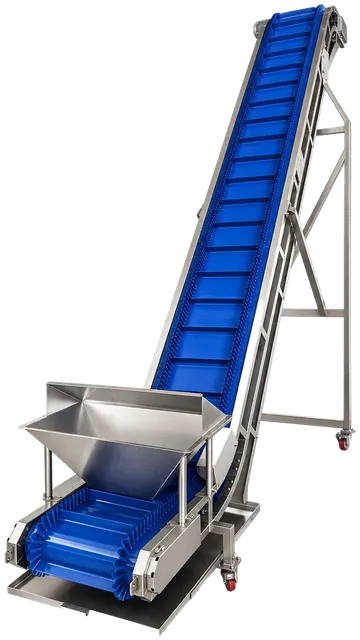
A conveyor moves material along a fixed route so that people do not have to. The seven types below cover most of what is installed in plants.
A conveyor is a machine that carries product from one place to another along a set path: flat, up a slope or between levels. It replaces hand carrying, and on a line that runs all day that is where most of its value comes from.
The parts differ by type. Some conveyors use a belt, some rollers, chains or a screw, and nearly all of them are driven by an electric motor through a gearbox. The notes below start with the idea itself and then go through the seven types in turn.
Seven conveyor types
Conveyor systems are divided into categories by the properties of the product, the conveying distance, the production capacity and the working environment.
1. Belt conveyor systems
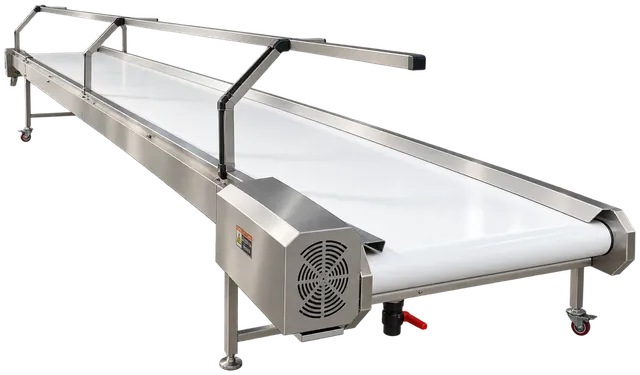
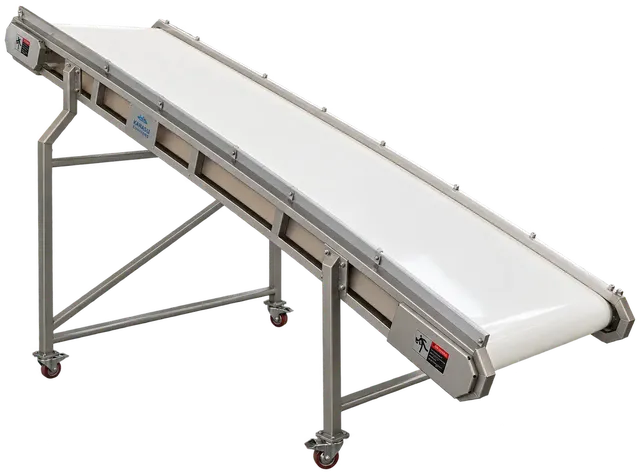
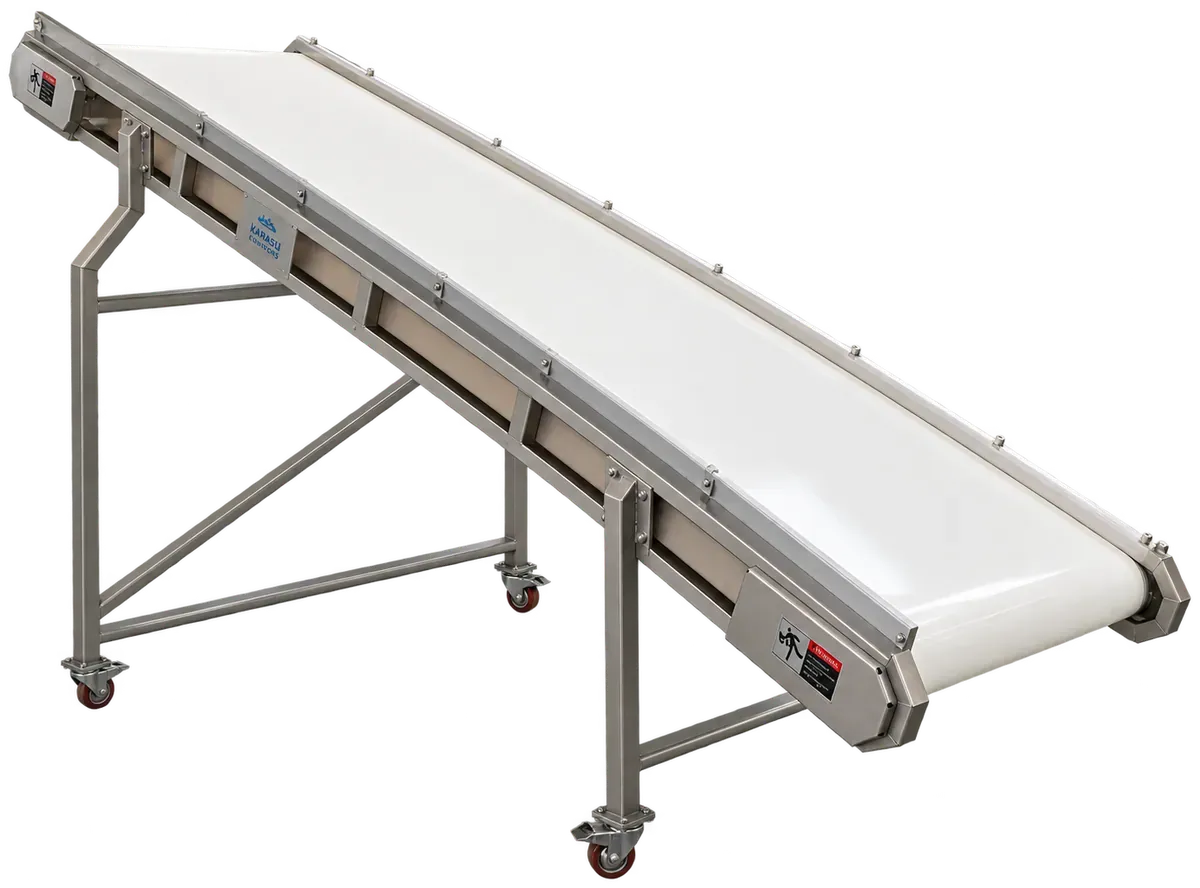
A belt conveyor carries the product on a moving belt.
The belt is usually driven by an electric motor and a gearbox. Belts can be made of PVC, PU, rubber or other materials that suit the application.
Belt conveyors are widely used in food processing, packaging, production and product transfer.
The width, length and running speed of the belt are set according to the needs of the plant.
2. Modular belt conveyor
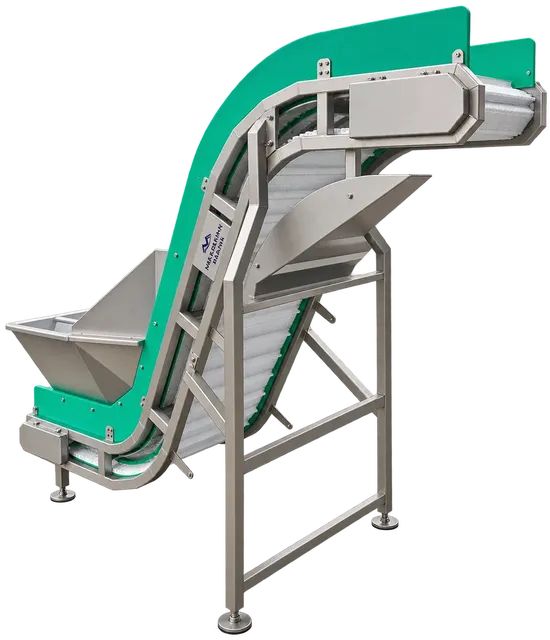
In a modular conveyor the carrying surface is made of linked plastic modules.
Modular belts can be built with different surface designs for straight conveying, inclined transfer, washing and water drainage.
Modular belt conveyors are preferred in food processing lines, in product washing systems and in production areas where there is a difference in height.
3. Z-type conveyor and modular elevator
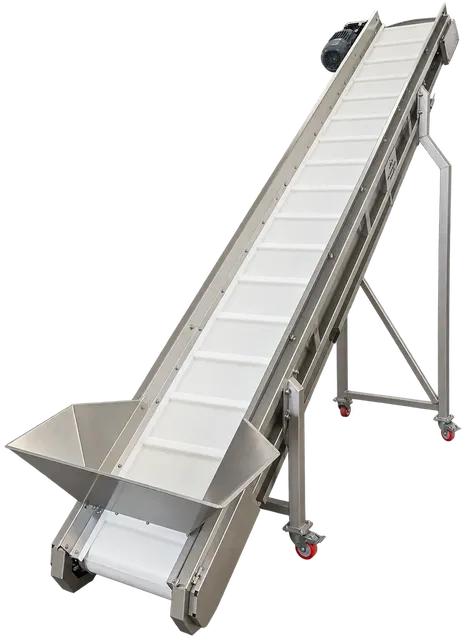
A Z-type conveyor is a special conveyor that lifts product from a low level to a high level.
Because of the Z-shaped route, product passes from a horizontal inlet section to an inclined section and then to the outlet at the upper level.
Z-type modular conveyors can be used on lines for dried fruit, vegetables, nuts and other granular products.
In the design, the angle of incline, the belt structure, the carrying cleats and the product properties have to be considered together.
4. Stainless steel conveyor systems
Stainless steel conveyors are used where hygiene, easy cleaning and corrosion resistance are needed.
Conveyors with an AISI 304 stainless steel frame are a common solution in food processing and packaging plants.
AISI 316 stainless steel can be considered for more aggressive chemical conditions or special processes.
Using stainless steel does not by itself mean a hygienic design. Weld quality, surface finish, drainage, connection details and access for cleaning matter as well.
5. Roller conveyor and roller transport systems
A roller conveyor lets products move over rotating rollers.
It is used mainly for cartons, crates, boxes and packaged goods.
There are gravity models and motor-driven models.
On packing and storage lines, roller conveyors make it easier to pass products between stations.
6. Screw conveyor and helical systems
A screw conveyor moves product inside a closed or semi-closed housing with a rotating helical screw.
It is chosen for powders, granules, crumbs and some bulk materials.
With suitable design and material selection, a stainless steel screw conveyor can also be used in food production plants.
7. Vibratory conveyor
A vibratory conveyor moves product in one direction by a vibrating motion.
Besides conveying, these machines can also spread the product, feed it evenly or screen it.
Vibratory conveying systems are used for granular food products, on dried-fruit processing lines and in industrial screening. See vibratory conveyor for how the trough moves product.
Where conveyors are found
Conveyor systems are an integral part of the production process in many industries.
Food industry: moving fruit, vegetables, nuts, dried fruit, bakery products and packaged food.
Agriculture: passing harvested product to cleaning, sorting, grading and packing stations.
Packaging industry: moving cartons, boxes, packs and pallets on production and packing lines.
Logistics and storage: sorting products, storing them and moving them to dispatch areas.
Chemical and plastics industry: moving granules and various raw materials with suitably designed systems.
Recycling plants: passing separated materials to the next piece of process equipment.
Because the product characteristics differ from sector to sector, the construction material, the conveying method and the safety features of a conveyor must be chosen for the application.
Choosing between them
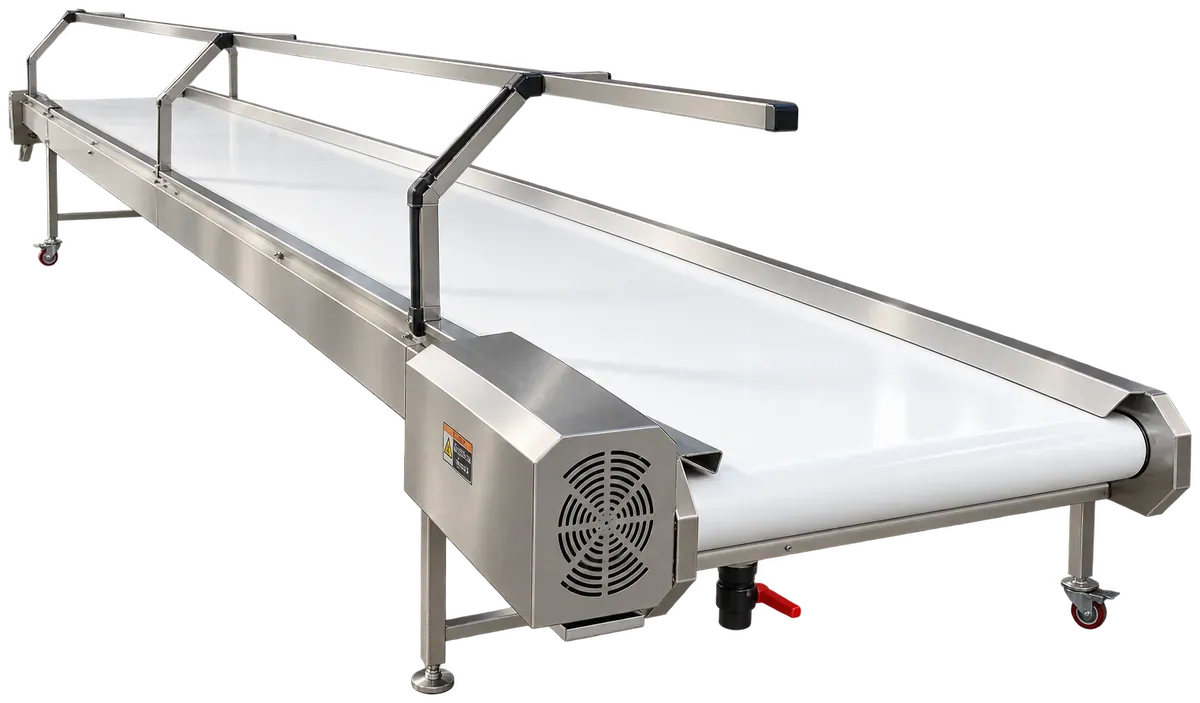
A correct choice is not made on belt length or motor power alone.
The weight, size, moisture content and abrasiveness of the product, the production capacity and the conveying distance are analysed together.
The working temperature of the line, the cleaning conditions, the layout and the automation needs also affect the design.
For example, for a food product with high moisture an open-surface modular belt may be preferred, while for packaged products PVC or PU belt conveyors can be sufficient.
In practice
A conveyor for a particular line is specified from three things: what is being carried, how much per hour and over what distance. With those three answers a manufacturer can propose a belt type, a frame material and a drive. The contact page names the manufacturer referenced on this site.