A rotating spiral pushes powder, granules and bulk material along a housing. This is how it works and where each type is used.
A screw conveyor, also called an auger, moves material by turning a spiral inside a housing. The material cannot rotate with the spiral, so it is pushed forward along the trough or tube instead. That simple action is the reason screws are common for powders, granules and other loose material.
The sections below explain the parts, the three steps of the process, the main types and the industries that use them, and they end with short answers to common questions.
What a screw conveyor is
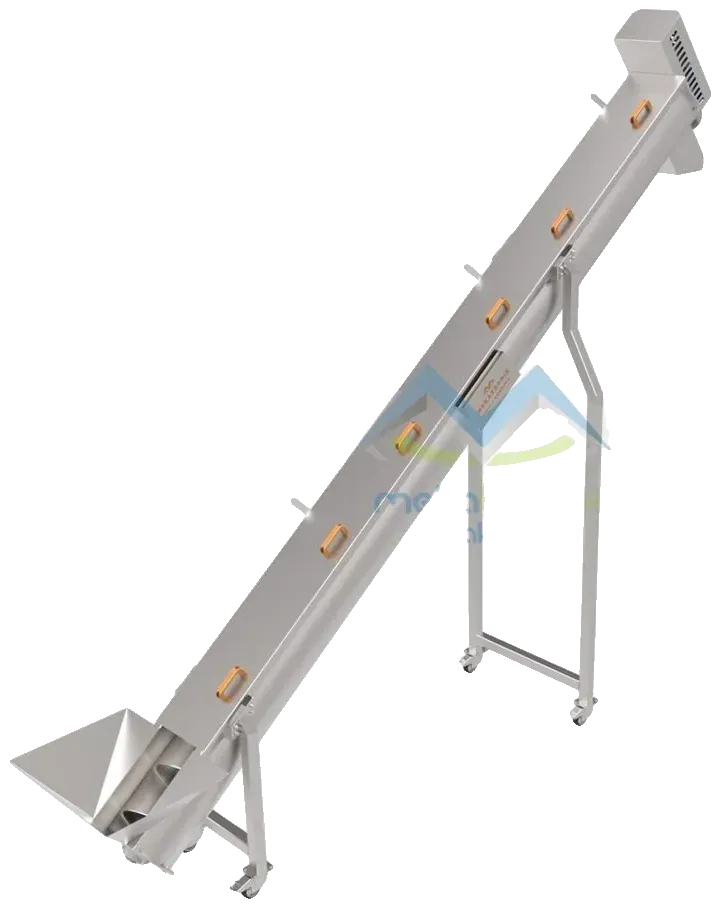
A screw conveyor is a mechanical conveying system in which spiral flights fixed to a rotating shaft move powders, granules, granular materials and some semi-solid materials horizontally, on an incline or, in special designs, vertically.
In industry, screw conveyor systems are also known as helical conveyors, screw feeders, auger conveyors and spiral conveyors.
The basic working principle is that the rotation of the spiral flights moves the material forward inside the housing.
These systems usually consist of an electric motor, a gearbox, a screw shaft, spiral flights, a conveying housing and bearings.
Depending on the properties of the material, the diameter, length, speed, angle of incline and housing material of the system can be set for the project.
How it works
The working mechanism of a screw conveyor is based on a rotating spiral motion.
The motion from the electric motor is usually passed to the screw shaft through a gearbox. As the spiral flights on the shaft turn, the material inside the housing moves toward the outlet.
The process has three basic stages.
1. Material feeding
The product to be conveyed is passed into the inlet hopper or feed opening of the screw conveyor.
Feeding can come from a silo, a hopper, a production machine or another conveyor system.
2. Conveying with the screw
The rotation produced by the electric motor is passed to the spiral flights.
The flights move the material through the conveyor housing in a controlled way.
Conveying capacity depends on the screw diameter, the pitch, the speed, the fill ratio and the physical properties of the product.
3. Product discharge
The conveyed material is passed from the outlet of the conveyor to the next piece of production equipment, a hopper, a mixer or a packing system.
Properly designed screw conveyor systems can be used for controlled feeding and dosing as well as for continuous material transfer.
Seven types of screw conveyor
Screw conveyors are made in different types according to housing structure, conveying direction, field of use and material properties.
The most common types are the following:
1. U-trough screw conveyor
A U-trough screw conveyor has a rotating spiral inside a conveying trough shaped like a U.
It is generally preferred for horizontal conveying.
The upper part can be designed with openable covers, which can make maintenance and cleaning easier.
U-trough screw conveyors can be used for flour, grain, pulses, granules, feed raw materials and various bulk materials.
Main advantages:
- suited to horizontal material conveying
- access for maintenance and cleaning
- different inlet and outlet points can be made
- capacity and length options made to the project
- can be made of stainless steel or other suitable industrial materials
U-trough screw systems can be designed in different sizes to suit the layout of the production line.
2. Tube-type screw conveyor
A tube-type screw conveyor is a closed conveying system in which the spiral runs inside a cylindrical tube housing.
It is preferred above all for materials in powder and granule form.
With a suitable sealing design, the closed housing helps reduce the spread of material into the surroundings.
Tube-type screw conveyors are used in flour mills, feed plants, food production, the chemical industry and plastic granule conveying.
In these systems the tube diameter, flight dimensions and motor capacity are set according to the properties of the material to be carried.
3. Stainless steel screw conveyor
A stainless steel screw conveyor is a screw conveying system that uses stainless steel in its housing and in the metal parts that touch the product.
It is preferred above all in the food, agriculture, cosmetics and chemical sectors.
AISI 304 stainless steel is one of the common materials in many food processing applications.
In certain applications that need higher corrosion resistance, AISI 316 stainless steel can be considered.
Stainless steel screw conveyors can be integrated into food production lines when suitable material and hygienic design conditions are met.
4. Inclined screw conveyor
An inclined screw conveyor is a type that moves material between different heights.
On production lines it can be used to pass product from a lower level to machines at a higher level.
In inclined screw conveyors, performance depends on the angle of incline, the flow properties of the product, the screw pitch and the speed.
As the angle of incline increases, the conveying capacity of standard screw designs can fall. For inclined applications the housing type and the spiral geometry therefore have to be considered specially.
5. Vertical screw conveyor
A vertical screw conveyor is a special screw system designed to move bulk materials with suitable flow properties in a vertical direction.
Vertical screws follow different design criteria from standard horizontal screw conveyors.
The screw speed, the inlet feed, the housing clearances and the motor power must be calculated for vertical conveying conditions.
With suitable products, these systems can be considered where height has to be gained in a limited floor area.
6. Shaftless screw conveyor
A shaftless screw conveyor is a conveying system with a spiral that has no central carrying shaft.
This design can help for some sticky, fibrous materials or materials that tend to wrap around a shaft.
Shaftless screw conveyors can be used in waste processing, sludge transfer and the conveying of suitable industrial materials.
The system should be chosen according to the abrasiveness and fluidity of the material and the conveying distance.
7. Dosing screw and screw feeder
Dosing screws are systems that feed a set amount of material into the production line in a controlled way.
They can be used for the controlled transfer of flour, sugar, spices, additives, granules and powder raw materials.
The screw speed can be adjusted with a frequency-controlled motor system.
Controlling the speed alone does not, however, mean that precise gravimetric dosing is achieved with every material. Applications that need high accuracy should use weighing and feedback systems.
Where screw conveyors are used
Screw conveyor systems are used in many industrial fields where products with different physical properties can be conveyed.
Screw conveyors in the food industry
In food production plants it is important to move raw materials safely and in a controlled way.
For this reason stainless steel screw conveyor systems are widely preferred in the food sector.
Properly designed screw conveyors can be used to carry products such as:
- flour and semolina
- sugar
- salt
- spices
- rice
- bulgur
- pulses
- starch
- food additives
- various powder and granule food raw materials
On screw conveyors used in food production, the product-contact surfaces must be cleanable, the material must be suitable and product residue must be controlled.
Agriculture and grain processing plants
In agriculture, screw conveyors are used to move grain, seed, feed raw materials and various bulk agricultural products.
These systems can be integrated into silo discharge, raw material feeding, product transfer and transfers inside the production line.
The grain size, moisture content and fragility of the product directly affect the choice of screw.
Flour and feed mills
In flour and feed production plants, raw materials have to be moved to different production machines.
Screw conveyors can be used in processes from silo outlets to mixers and from mills to storage points.
A closed housing design can be an important advantage when carrying dusty products.
Where combustible dust may be present, the explosion risk must be assessed separately.
Dried-fruit and nut processing plants
In dried-fruit and nut processing plants, screw systems can be used to carry some crumbs, broken product, powders or auxiliary materials in granule form.
For whole dried apricots, figs, raisins and similar delicate products, however, a screw conveyor is not always a suitable option.
Where there is a risk of the product being crushed, broken or sticking, belt conveyors, modular conveyors or vibratory conveying systems may be more suitable.
For this reason the choice of conveying system on a dried-fruit line has to be made according to the physical properties of the product.
Chemical industry
In the chemical sector, screw conveyor systems can be used to move powder and granule raw materials.
Closed tube-type screws give controlled material transfer with a suitable sealing design.
The abrasiveness, reactivity and process temperature of the chemical product decide the choice of housing material.
Plastics and granule conveying
In the plastics sector, screw conveyors can be used to carry granules, ground plastic and polymer raw materials with suitable physical properties.
These systems can be integrated into extrusion, mixing, feeding and raw material transfer applications.
Recycling and waste processing
In recycling plants, screw conveying systems are used to move some broken, shredded or granulated materials.
The abrasive effect of the material, its moisture and the foreign material it may contain have to be considered at the design stage.
Differences between a screw conveyor and a belt conveyor
Screw conveyors and belt conveyors serve the same basic purpose, moving material, but they work differently.
On a belt conveyor the product moves on a moving belt, while on a screw conveyor the material is carried by rotating spiral flights.
Screw conveyors can be suitable for carrying powders, granules and bulk materials inside a closed system.
Belt conveyors, on the other hand, can help for fragile, shaped, packaged or delicate products.
The choice comes down to the properties of the product, the production capacity, the cleaning requirements and the conveying route.
What sets the capacity
Conveying capacity is one of the most important engineering parameters in screw conveyor design.
When screw conveyor capacity is calculated, the following technical information is taken into account:
- outer diameter of the screw
- diameter of the centre shaft
- spiral pitch
- revolutions per minute
- bulk density of the material
- fill ratio of the screw
- conveying length
- angle of incline
- flow and friction properties of the material
For example, a high-density product and a low-density product can have different mass capacities in the same screw system.
For sticky, damp or poorly flowing materials, a standard screw geometry may also not be enough.
The screw diameter and motor power should therefore be set not only from a target tonnes per hour, but from the real process conditions of the material.
Choosing a screw conveyor
To choose a screw conveyor for a production line, the material properties and the process needs are considered together.
The grain size, density, moisture content, stickiness and abrasiveness of the product are especially important.
The conveying distance, the angle of incline, the hourly capacity and the daily running time also affect the machine design.
For systems used in the food sector, hygienic design, suitable product-contact materials and ease of cleaning should be among the first criteria.
In industrial plants, operating safety, access for maintenance and the right choice of motor and gearbox group matter for long service.
Short answers
What is a screw conveyor?
A screw conveyor is a mechanical conveying system that moves powders, granules and various bulk materials with rotating spiral flights.
Is a helical conveyor the same machine as a screw conveyor?
Yes. The terms helical conveyor and screw conveyor are used in industry for conveying systems with the same basic working principle.
What materials does a screw conveyor carry?
Flour, sugar, grain, feed raw materials, plastic granules and various powder or bulk materials can be carried. Suitability depends on the physical properties of the material.
Where are stainless steel screw conveyors used?
Stainless steel screw conveyors are preferred above all in food, agriculture, cosmetics and certain chemical production applications.
How much does a screw conveyor cost?
The cost of a screw conveyor depends on the housing material, the spiral diameter, the conveying length, the motor power, the automation and any special design needs.
What is the difference between a U-trough screw and a tube-type screw?
U-trough screws can offer an advantage in access for maintenance, while tube-type screws, with their closed housing, are preferred for the transfer of powder and granular material.
Can a screw conveyor convey vertically?
Yes. Vertical conveying, however, needs a special screw geometry, suitable speed and different engineering calculations. Not every standard screw conveyor is suited to vertical conveying.
Which stainless steel is used in screw conveyor manufacture?
AISI 304 stainless steel is widely preferred in food and industrial applications. AISI 316 can be used in certain applications that need higher corrosion resistance.