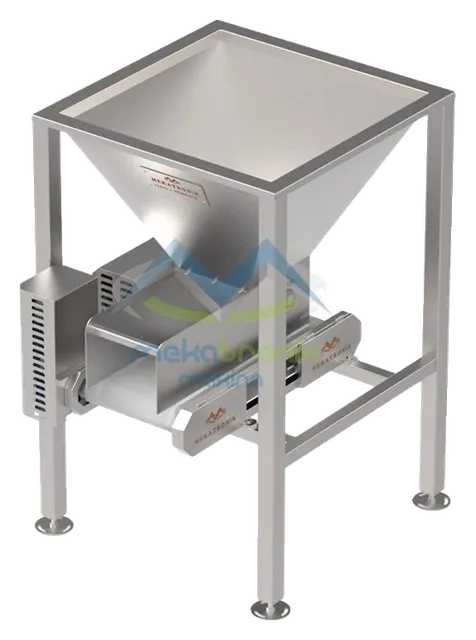
Both feeders move product from a hopper at a controlled rate. They differ in what touches the product, how pieces are separated and how the machine is cleaned. For sticky dried fruit these differences decide the choice.
What the head of the line needs
Product is often emptied by hand into the first machine. The first machine has to take that uneven load and pass it on at an even rate. If it fails at this, every machine after it sees surges: the screen deck fills in some seconds and runs empty in others, and the sizing result suffers.
The feeder also has to deal with pieces that arrive stuck together. Raisins, apricots, figs and dates often come out of a bin in clusters.
How a belt feeder works
A belt feeder carries product on a moving belt under a hopper opening. The rate is set by the belt speed and by the height of the gate. The belt gives a smooth, gentle transfer and works well for firm, free-flowing items.
Its weak points with dried fruit are the belt itself and the layer it carries. Sticky fruit leaves residue on the belt surface, which has to be cleaned or scraped. The belt carries clusters through as they are, because nothing acts on them. The edges, rollers and return path add parts that need washing. The article on conveyor belt types shows how belt material affects cleaning.
How a vibratory hopper feeder works
The vibratory hopper feeder takes in product emptied by hand and feeds the next machine at an even rate. Agitators in the trough help break the product up into single pieces. Product goes into the trough, the agitators separate the pieces, and the product passes to the next stage.
The listed products are raisins, dried apricots, dried figs and dates. The body and contact surfaces are AISI 304 stainless steel, with AISI 316 optional depending on the process. The drive is a geared motor, control is by PLC or stand-alone, and the supply is 380 V / 50 Hz. The trough is of easy-to-clean construction.
Comparing them on the points that matter
Sticky product. The trough with agitators acts on clusters. A belt does not. If the product tends to clump, this alone often decides the matter.
Even rate. Both can feed evenly when set correctly. A vibratory feeder changes the rate through its drive. A belt feeder changes it by speed or gate. With a poorly set gate, a belt can still deliver surges.
Cleaning. A stainless trough has few parts and smooth surfaces. A belt has the belt, the rollers, the tracking parts and the area underneath. Washdown between products or between shifts is usually quicker on the trough.
Gentleness. A belt is gentle on fragile pieces. A trough can be gentle too when set properly, but a long drop from the discharge edge to the next machine can damage soft fruit with either type, so the transfer height is worth checking.
Space. A belt feeder tends to be longer in the line of flow. Dimensions of the vibratory feeder are made to suit the installation.
Floor loads. A vibrating machine passes motion to its support. It needs sound mounts and a structure that takes the vibration, a point covered in the maintenance guide.
A simple way to decide
Ask these in order:
- Does the product arrive in clumps? If yes, favor the feeder with agitators.
- Is the product sticky or wet at the surface? If yes, favor the feeder that cleans quickly.
- Is the product firm, dry and free-flowing, and is the line long enough to take a belt? A belt feeder is a reasonable choice.
- Is the next machine a screen? An even feed across the deck width matters a great deal there, as described in the guide on screening efficiency.
Capacity
The capacity is set per project, so a number from a catalogue would mislead. The product, the clump level and the rate of the line all enter into it.