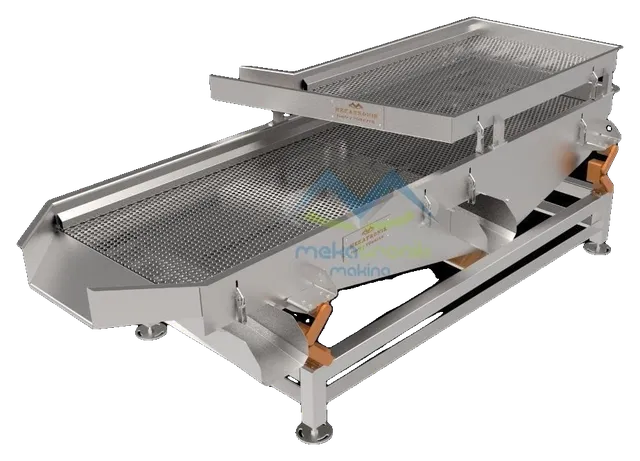
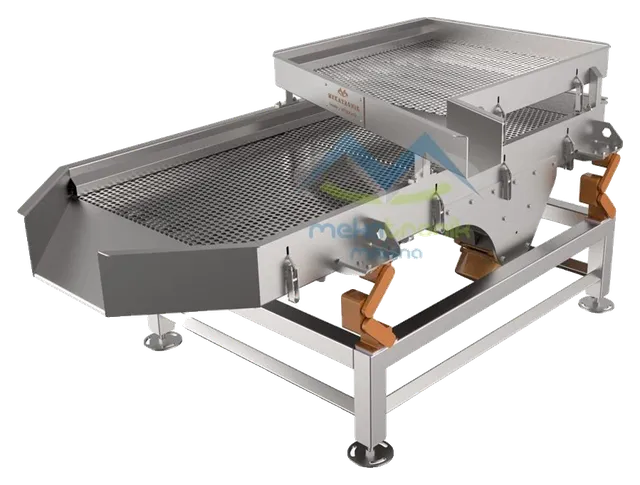
A vibrating screen cleans and classifies food in one pass. This page covers how it works, where it sits in the line and what to settle before choosing one.
Vibrating screens are used wherever a food has to be cleaned, graded or both before the next step. They sit in dried-fruit lines, nut plants, mills, spice packers and coffee roasteries, and the machine is much the same in all of them: a stainless steel body, one or more screen decks and one or more vibration motors.
What differs is the product. The notes below start with the machine and how the product moves on it, go through the products one by one and finish with where the screen belongs in a line and what to settle before choosing one. For size grading in particular, see grading screens in food processing.
What the machine is made of
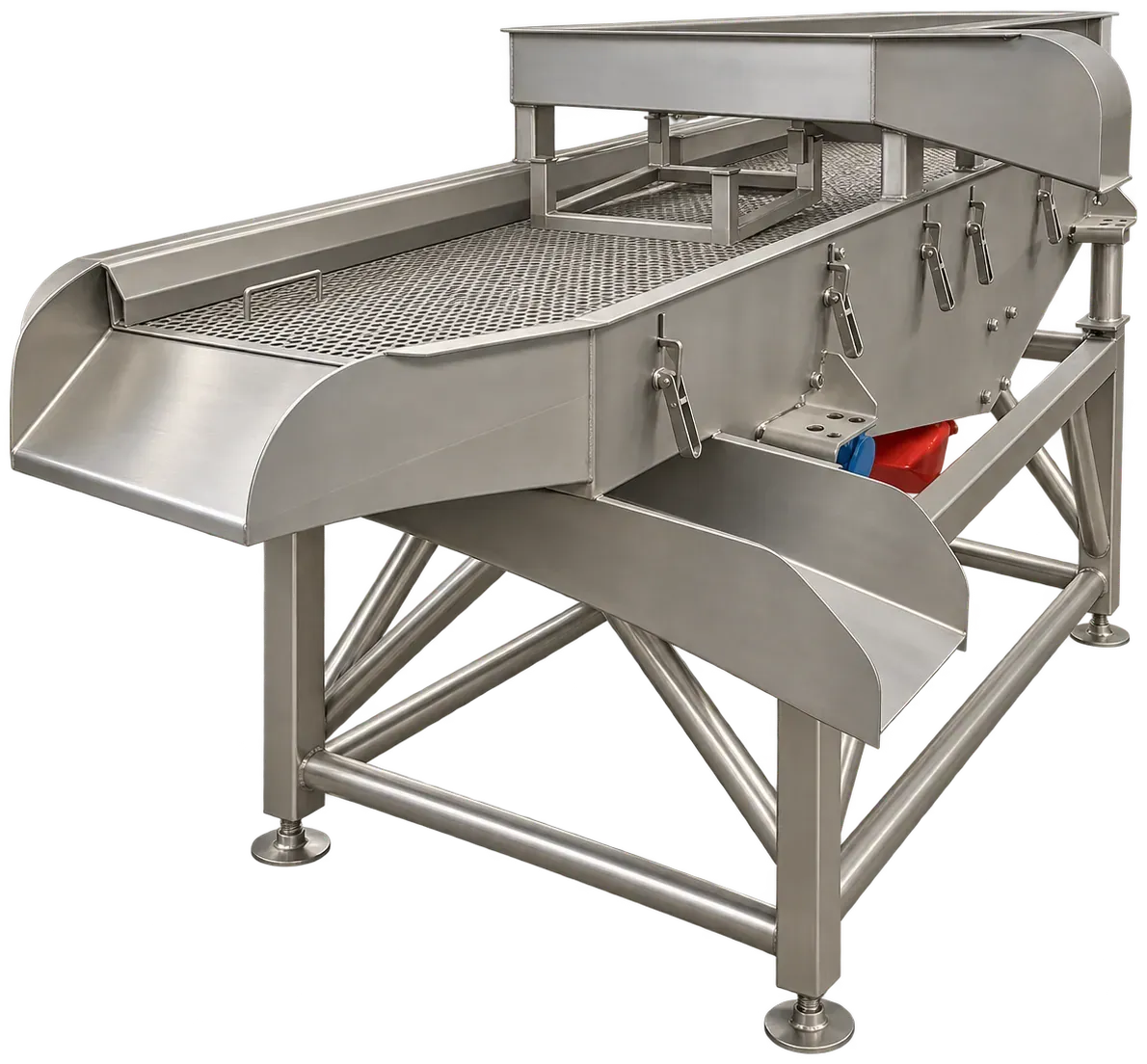
A vibrating screening machine is a mechanical classification system in which the product moves over a screen surface by vibration and pieces of different sizes are separated according to the screen openings.
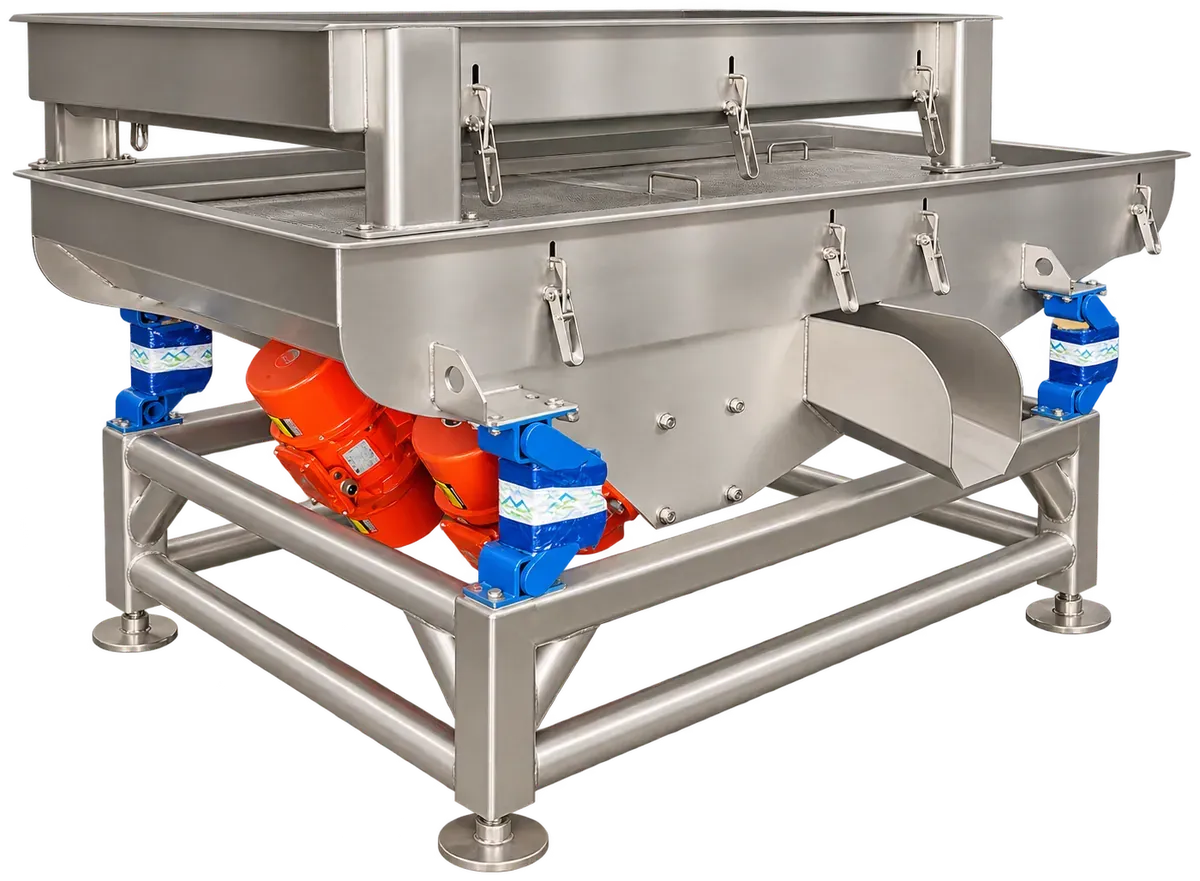
The machine generally consists of the following main components:
- stainless steel housing
- screen surface
- vibration motor
- frame
- product inlet hopper
- product outlets
- covers
- springs or vibration mounts
- control system
When product is fed to the machine, a controlled vibration spreads it over the screen surface. Pieces smaller than the opening pass through, while larger pieces move along the screen and are taken from different outlets.
With this system, screening, classification and the separation of some foreign material can be done at the same time.
How the product moves
The basic working principle of a vibrating screen system is controlled vibration.
Vibration motors or eccentric mechanisms give the housing a certain motion. With this motion the product:
- spreads over the screen surface
- moves forward
- passes through the screen openings if it is small
- travels toward the end of the screen if it is large
- is taken in separate fractions from separate outlets
The vibration frequency and amplitude have to be set for the type of product.
Flour, raisins, chickpeas and hazelnuts do not all work efficiently with the same vibration character.
The capacity of a vibrating screen should therefore be set not only by the size of the machine but also by the physical properties of the product.
Products, sector by sector
Dried fruit
Vibrating screen systems are very widely used on dried-fruit processing lines.
They can be used for products such as:
- raisins
- dried apricots
- dried figs
- dates
- dried plums
- dried tomatoes
- dried mulberries
- blueberries
- diced dried fruit
On dried-fruit lines a vibrating screening machine can be used to:
- separate small foreign material
- screen out broken product
- classify products by size
- make the product uniform before packing
Nuts
In nut production plants, a vibrating screen can be used to classify and clean products such as:
- hazelnuts
- almonds
- pistachios
- peanuts
- walnuts
- cashews
- sunflower seeds
- pumpkin seeds
The screen opening geometry is very important for these products.
A wrong screen type can cause the product to jam or break.
Grain and pulses
Vibrating screening machines can be used for pre-cleaning and classification of products such as:
- wheat
- barley
- maize
- rice
- bulgur
- lentils
- chickpeas
- beans
- peas
In the grain and pulse sector, vibrating screens play an important part in separating small stones, broken grains and dust.
Flour and milling
In flour mills and powder processes, vibrating screen systems can be used for:
- flour
- semolina
- bran
- starch
- powder mixes
In these applications, control of fine particles and the separation of lumps are important.
Closed-type vibrating screen systems are an advantage in reducing dust.
Spices
In spice production plants, products such as:
- chilli flakes
- ground chilli
- cumin
- black pepper
- thyme
- cinnamon
- coriander
- turmeric
- spice blends
can be passed through vibrating screening systems.
The aim is to separate coarse or fine pieces in the product and to make the product structure uniform.
In the spice sector, easy cleaning is especially important.
This is because there can be a risk of aroma transfer and cross-contamination when the product is changed.
Sugar and confectionery
Vibrating screens can also be used for:
- crystal sugar
- icing sugar
- granulated sugar
- confectionery raw materials
- granular mixes
These systems are effective especially in separating lumps and controlling particle size.
Coffee and cocoa
In coffee and cocoa production, the following can be passed through screening and classification:
- coffee beans
- ground coffee
- cocoa pieces
- cocoa powder
With ground products, the screen openings and the vibration character must be set according to the particle structure that is wanted.
Seeds
In seed processing plants, vibrating screening machines are used for:
- sunflower seeds
- pumpkin seeds
- sesame
- chia
- flax seed
- agricultural seeds
- vegetable seeds
In the seed sector, a uniform size distribution is important for commercial quality.
Material
On vibrating screening machines used in the food sector, the choice of material is extremely important.
AISI 304 stainless steel is generally used in the areas that touch the product.
AISI 316 stainless steel can be preferred for more aggressive products or in plants that use intensive chemical cleaning.
The advantages of stainless steel vibrating screen systems can be listed as:
- hygienic surface
- ease of cleaning
- corrosion resistance
- long service life
- a structure suited to food production
- resistance to washing
In the food sector, using stainless steel alone is not enough, however.
The geometry of the machine must also suit a hygienic design.
Hygienic design
In a well-designed food-grade vibrating screening machine:
- dead spots should be kept to a minimum
- product build-up should be prevented
- the screens should be easy to remove
- access to the areas to be cleaned should be easy
- weld surfaces should be smooth
- sharp inside corners should be reduced
- there should be enough space under the machine for cleaning
- electrical equipment should be protected to suit the working environment
These features directly affect the hygiene level of the machine.
Capacity
Many factors decide the capacity of a vibrating screening machine.
They can be listed as:
- density of the product
- grain size of the product
- moisture content of the product
- stickiness
- screen surface area
- screen opening
- vibration frequency
- vibration amplitude
- feed rate
- screen incline
The same vibrating screen can give very different tonnes per hour with different products.
For this reason it is not always right to give a single capacity value in a catalogue.
Foreign material
Vibrating screen systems are effective especially in separating foreign material that differs in size.
For example:
- sand
- stones
- broken pieces
- dust
- coarse foreign material
can be separated according to the screen openings.
A vibrating screen does not replace:
- X-ray
- metal detector
- optical sorter
- laser sorter
Advanced control systems may be needed to detect pieces of metal, glass or stone of the same size as the product.
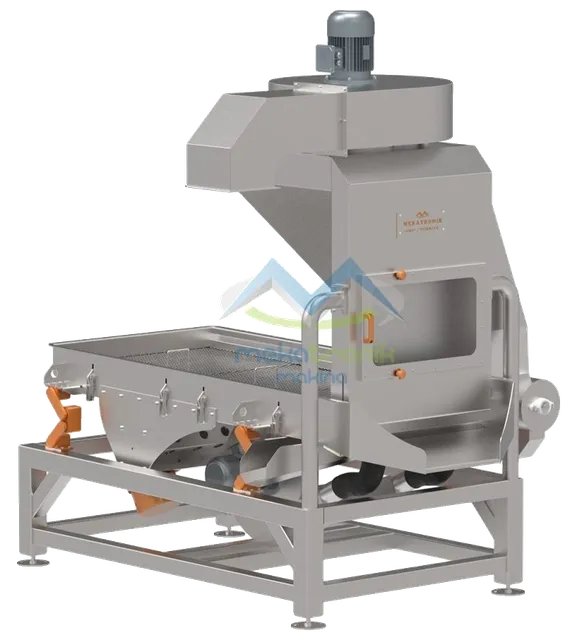
With aspiration
When vibrating screening systems are used together with an aspiration system, more effective pre-cleaning can be done.
While the vibrating screen separates by physical size, the aspiration system can remove foreign material of low density.
For example:
- leaves
- stalks
- light husks
- dust
- light foreign material
can be separated by an air stream.
This combination gives strong results especially in the dried-fruit, pulse and grain sectors.
Before packing
Using a vibrating screen before packing can increase the uniformity of the product.
In this way:
- filling machines run more steadily
- pack weight is more even
- the share of broken product falls
- the appearance of the pack improves
Product standardisation is very important especially for premium packed products.
Before an optical sorter
On modern production lines a vibrating screen can be used before an optical sorter.
Mechanical grading and screening is done first.
The optical sorter can then sort out:
- colour defects
- foreign material
- damaged product
- colour differences
When these systems are used together, product cleanliness and the quality standard rise considerably.
Where it sits in the line
The position of the machine on the production line changes with the product and the process.
A vibrating screen can be used:
- after raw material intake
- at the pre-cleaning stage
- before washing
- after drying
- before grading
- before packing
Correct positioning affects the efficiency of the whole line.
Questions to settle before choosing
Before a machine is chosen, the following should be settled:
- Which product will be screened?
- What is the capacity in kg per hour or tonnes per hour?
- What is the grain size of the product?
- How many different fractions are wanted?
- Is the product dry or damp?
- Is the product sticky?
- Is the product delicate?
- What should the screen opening be in mm?
- Will the machine be washed?
- Is AISI 304 or AISI 316 needed?
- What are the inlet and outlet heights of the machine?
- Which equipment will the machine work with?
If this information is set correctly, a much more efficient system can be designed.