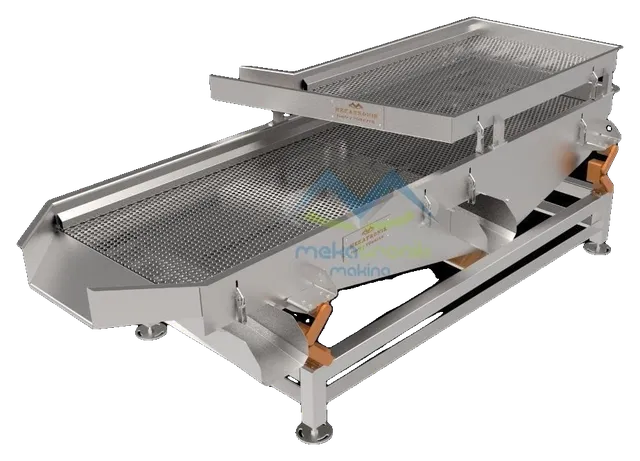
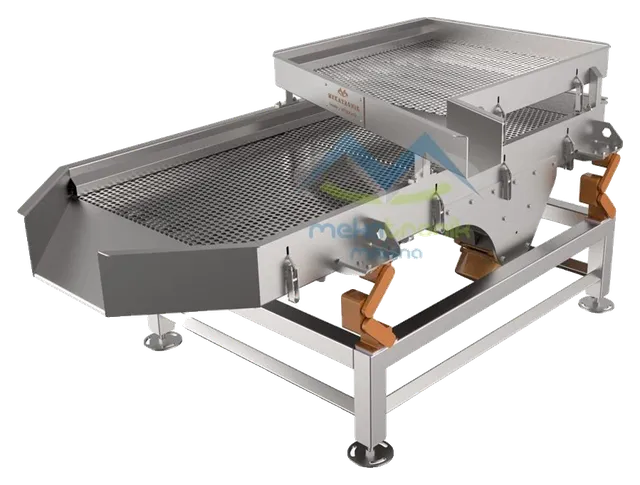
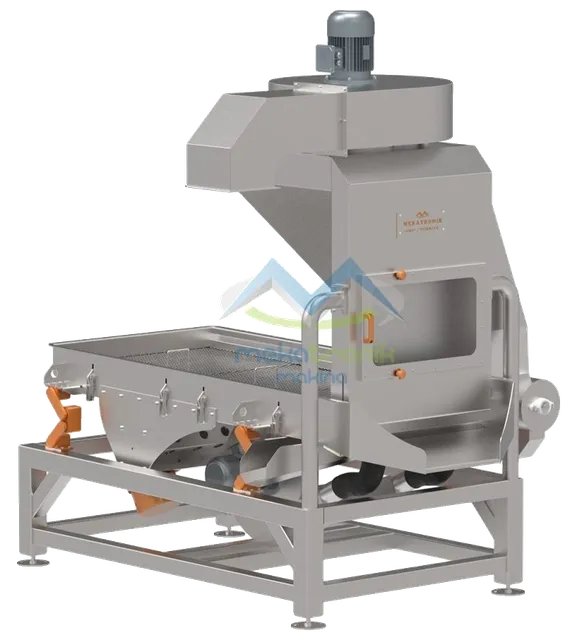
A grading screen sorts product into size classes. The openings, the number of decks and the vibration all have to fit the product.
Sorting by size is a separate job from cleaning. A bag of raisins or apricots can be clean and still look uneven, and in export and premium packs unevenness is read as lower quality. A grading screen takes that job: product moves over screens with openings of set sizes, and each size leaves through its own outlet.
The sections below explain how the sorting happens, which products are graded, how the screen openings and decks are chosen and where a grading screen cannot replace other equipment.
What a grading screen does
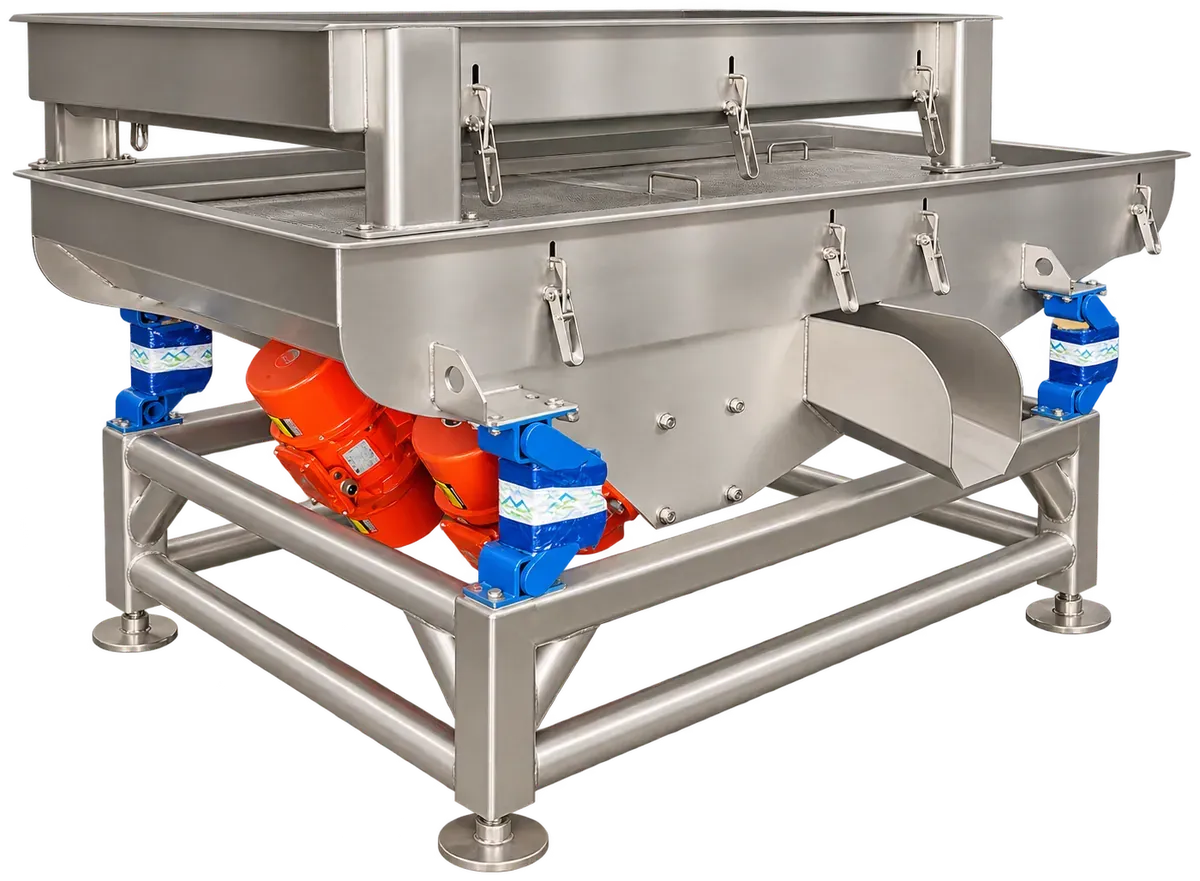
A grading screen is a machine that moves the product along the screen surface with a vibrating motion and separates it by size with screens that have different opening sizes.
On the machine the product:
- is fed onto the screen surface
- moves forward with a controlled vibration
- passes down through the suitable screen openings if it is small
- moves on to the next section if it is large
- is divided into several sizes if more than one screen is used
With this process, products of different sizes within the same batch can be classified automatically.
How the sorting happens
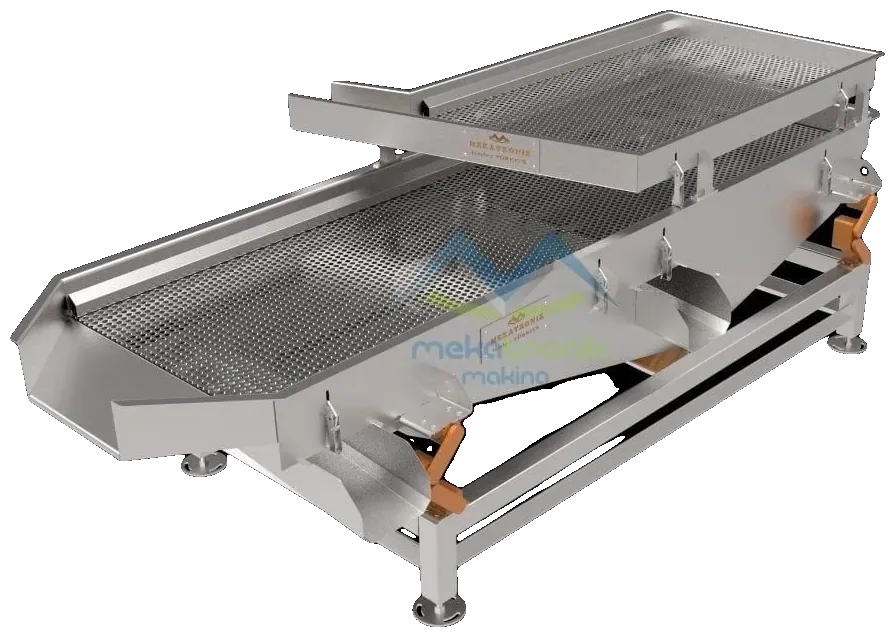
The working principle of a grading screen is mechanical vibration.
A vibration motor or an eccentric system gives the screen body a motion of a set frequency and amplitude.
With this motion the product moves along the screen in a controlled way.
The screen openings are made to the size of the product.
For example, if three sizes are wanted, the system can be designed with three outlets:
- small product
- medium product
- large product
For more precise classification, screen systems with four, five or more stages can also be used.
The capacity of a grading screen and the size of the screen openings therefore have to be set from the physical structure of the product to be processed.
Products that are graded
With different screen designs, grading screens can be used for a very wide range of products.
Dried fruit
Grading machines are widely used on dried-fruit processing lines.
Products such as:
- raisins
- dried apricots
- dried figs
- dates
- dried plums
- dried tomatoes
- dried mulberries
- blueberries
- dried fruit pieces
can be classified with grading screens.
In designing the screen for dried fruit, not only the diameter of the product but also its stickiness, fragility, moisture content and shape must be considered.
For example, dried apricots and raisins cannot be graded efficiently with the same screen geometry.
Nuts
In nut processing plants, grading screens can be used to classify products such as:
- hazelnuts
- almonds
- walnuts
- pistachios
- peanuts
- cashews
- sunflower seeds
- pumpkin seeds
In the nut sector, grading can directly affect the commercial value of the product.
Because products of different calibres can be sold at different prices, precise classification is important.
Pulses and grain
Grading and screening machines can also be used to process products such as:
- chickpeas
- lentils
- beans
- peas
- wheat
- barley
- maize
- rice
- bulgur
In these applications, along with classification by diameter it is also possible to separate broken grains and fine particles.
Seed and kernel processing
Seed processing plants need precise screening to obtain a uniform product.
Grading screens can be used for:
- sunflower seeds
- pumpkin seeds
- sesame
- chia
- flax seed
- agricultural seeds
- vegetable seeds
In the seed sector, size standards matter for sowing performance and packing quality.
Spices
Vibrating screen systems can also be used in spice production.
For example:
- chilli flakes
- black pepper
- cumin
- thyme
- coriander
- dried herbs
- granular spice blends
can be separated by size.
With powder products, a grading screen is used mostly for particle classification and for separating foreign particles.
Vegetables and processed food
For certain product forms:
- chopped vegetables
- frozen products
- diced foods
- dried vegetables
- broken products
can also be passed through vibrating grading systems.
Here the screen geometry has to be designed specially for the shape of the product.
Materials
On grading machines used in the food sector, one of the most important points is the choice of material.
AISI 304 stainless steel is generally preferred in the areas that touch the product.
In applications that need higher corrosion resistance, AISI 316 stainless steel can be used.
The advantages of stainless steel grading screens can be listed as:
- hygienic surface
- ease of cleaning
- corrosion resistance
- long service life
- suitability for food production environments
- a structure suited to washing
Stainless steel on its own does not make a design hygienic, though.
The machine has to be designed so that it is easy to clean, accessible and keeps product build-up to a minimum.
More than one deck
If several product sizes are wanted, multi-deck or multi-stage grading screens can be used.
For example, if four sizes are wanted, the system can give separate outlets for:
- very small product
- small product
- medium product
- large product
As the number of decks increases, more classification can be made on the same machine.
Using more screens than a product needs is not right, however.
The number of screens is set by considering:
- product variety
- number of calibres wanted
- capacity
- size distribution of the product
- available space
Changing screens between products
In food production plants, being able to use the same machine for different products is an important advantage.
For this reason an interchangeable screen system can be preferred on grading screens.
By changing screens with different opening diameters:
- different products
- different size classes
- different calibres
can be processed on the same machine.
This system is a particular advantage for plants that process seasonal products.
For example, if the same plant processes dried apricots, dried figs, dried plums or raisins in different periods, it can adapt to the different products simply by changing the screen sets.
The shape of the openings
Grading performance does not depend only on the diameter of the screen opening.
Depending on the shape of the product, the following can be used:
- round openings
- oval openings
- slot openings
- elongated openings
- laser-cut screens of special form
Round openings can suit round products, while slot screens can give a more accurate result with long products.
A sample of the product should therefore be examined before the screen is designed.
A wrong screen geometry can cause:
- product jamming
- a drop in capacity
- wrong classification
- product damage
What limits capacity
The capacity of a grading machine does not depend only on the width of the machine.
The main factors that affect capacity can be listed as:
- density of the product
- size of the product
- moisture content
- stickiness
- screen opening
- screen surface area
- vibration frequency
- vibration amplitude
- feed rate
- time the product stays on the screen
The same machine can give a different capacity with raisins, with dried apricots and with chickpeas.
When the price and capacity of a grading screen are evaluated, work must therefore always be done product by product.
Setting the vibration
The vibration setting is a key factor for grading performance.
If the vibration is too low, the product may not move forward enough.
With too much vibration:
- the product can bounce
- screening accuracy can fall
- the product can be damaged
- noise and mechanical load can increase
A vibration character suited to the structure of the product must therefore be set.
In inverter-controlled systems the best working point for different products can be found by adjusting the motor speed.
Using a grading screen as a pre-cleaner
Grading machines are not used only to divide products by size.
With a suitable screen system:
- dust
- sand
- broken product
- small foreign material
- fine particles
can be separated from the main product.
On some lines a grading screen can therefore also be used as a pre-screening machine.
On dried-fruit, pulse and grain lines in particular, pre-screening can reduce the load on the machines that follow.
What it cannot remove
Foreign material that is smaller or larger than the screen opening can be separated mechanically.
There is an important point here, however.
A grading screen is not an alternative to foreign material control machines such as:
- metal detector
- X-ray
- laser sorter
- optical sorter
A grading screen classifies by physical size difference.
Additional control systems may be needed to detect glass, stone, metal or foreign material very close to the size of the product.
Before an optical sorter
On modern food processing lines a grading screen and an optical sorter can be used together.
The product is first graded mechanically.
After that:
- colour defects
- foreign material
- damaged product
- products of a different colour
can be separated by an optical sorter or laser system.
This combination can raise product quality considerably.
Ahead of packing
Grading before packing can improve filling performance.
With pack formats such as:
- 250 g
- 500 g
- 1 kg
- 5 kg
- 10 kg
- 15 kg
- 25 kg
a more uniform product improves the appearance of the pack.
Packing products of the same size strengthens the perception of a premium product.
Position on a dried-fruit line
In dried-fruit processing plants a grading screen can generally be placed:
- after washing
- after drying or dewatering
- before sorting
- before packing
The line design changes with the product.
For example, on a raisin line, screening and grading can be done at a different point, while on date and dried apricot lines a different process order can be preferred.
The position of the machine on the production line must therefore be set product by product.
Hygiene
In a well-designed grading machine for the food sector:
- dead spots where product can collect are kept to a minimum
- the screens can be removed easily
- access for cleaning is easy
- the housing is suited to washing
- weld surfaces are smooth
- stainless steel surfaces can be cleaned easily
- electrical equipment is protected to suit the working environment
- there is enough space under the machine for cleaning
These features make the machine an advantage not only during production but also during cleaning and maintenance.
What the manufacturer needs to know
To choose the right machine, the manufacturer needs to know:
- What is the product?
- Is the product dry or damp?
- What is the target capacity in kg per hour or tonnes per hour?
- How many different sizes are wanted?
- What are the size ranges?
- Is the product round, oval or long?
- Is the product sensitive to breaking?
- Will the machine be washed?
- Is AISI 304 or AISI 316 needed?
- Which equipment will feed the machine?
- Where will the product go after the machine?
- What are the floor dimensions?
Without this information, choosing a machine on screen size alone is not right.