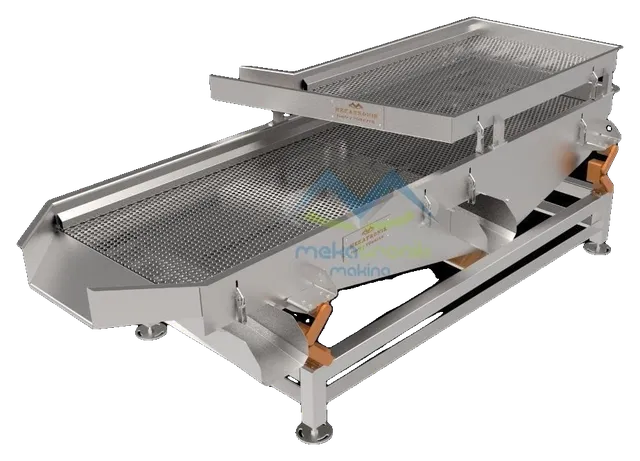
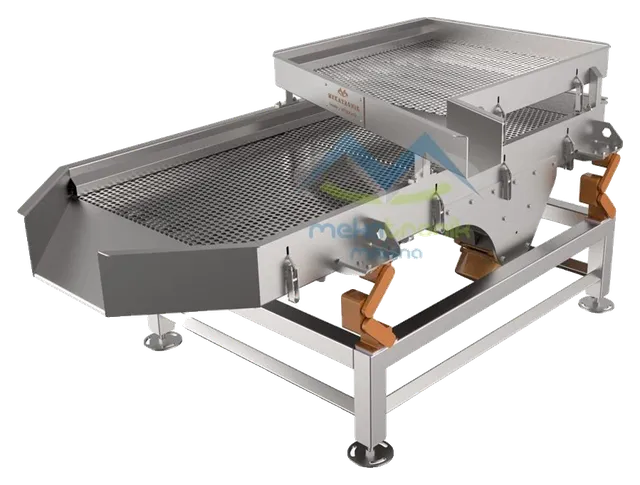
A screen separates by size only. Anything that is the size of the product, or lighter or denser than it, needs other equipment.
A vibrating screen separates product by size. That makes it good at removing dust, sand, broken pieces and small stones, which is why many food lines put one at the start of cleaning and another just before packing. It cannot find foreign material that is the same size as the product, and that is where other equipment takes over.
For the working principle and the screen types, see vibrating screens for food lines.
The screen as a pre-cleaner
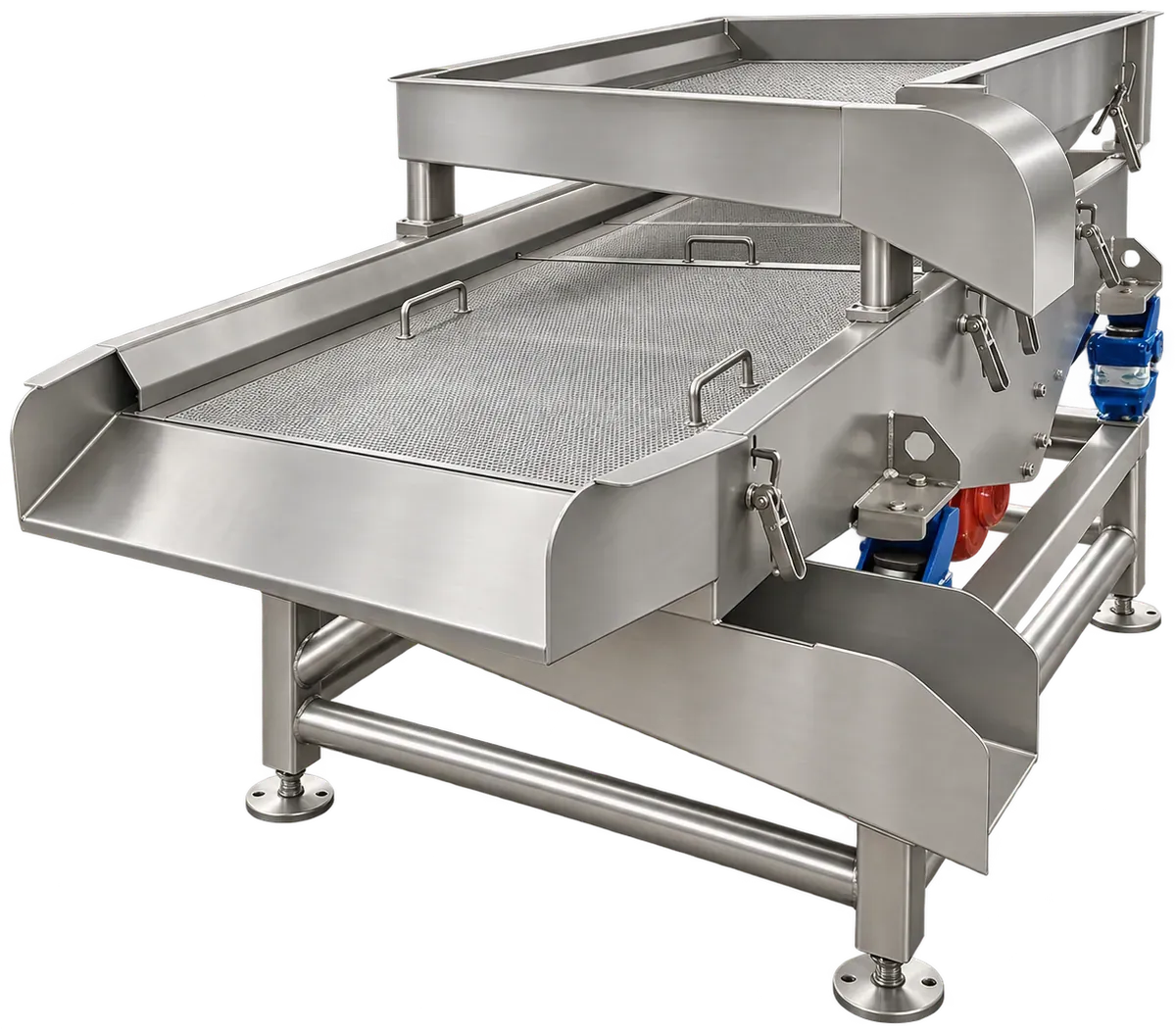
In many plants a vibrating screen is also used as a pre-cleaning machine.
With a suitable screen structure, the following can be separated from the main product:
- dust
- sand
- broken product
- small stones
- small foreign material
This reduces the load on the machines that follow.
Adding aspiration
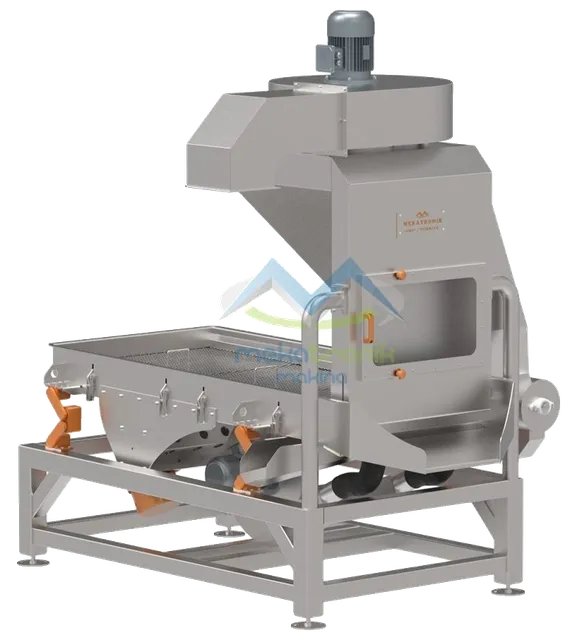
When a vibrating screen is used together with an aspiration system, much more effective cleaning can be done.
While the vibrating screen separates the product by size, aspiration separates materials of low density with an air stream:
- leaves
- husks
- light stalks
- dust
- light foreign material
This combination is very effective especially on dried-fruit, grain and pulse lines.
Metal
A vibrating screen can separate small foreign material by the difference in size.
For the reliable detection of pieces of metal, however, a metal detector must be used.
When a vibrating screen and a metal detector are used together, mechanical screening and metal control are both provided.
X-ray, laser and optical sorting
On lines that need high quality, the following can be used after the vibrating screen:
- optical sorter
- laser sorter
- X-ray machine
- metal detector
These machines take on different tasks.
Vibrating screen: separates by size.
Optical sorter: separates colour and appearance defects.
Laser sorter: can separate according to more advanced optical properties.
X-ray: detects foreign material that differs in density.
Metal detector: checks for metal contamination.
On a modern food line these systems are therefore not alternatives to each other; they complete each other.
The last screen before the pack
Using a vibrating screen before packing:
- raises the uniformity of the product
- reduces broken pieces
- improves the appearance of the pack
- helps the filling systems to run more steadily
On retail packing lines in particular, product standardisation matters for sales quality.
Hygiene
On a vibrating screening machine to be used in the food sector:
- the points where product can collect should be kept to a minimum
- the screens should be easy to remove
- the inside of the machine should be easy to clean
- the welds should be smooth
- dead spots should be reduced
- stainless steel surfaces should be easy to wash
- there should be cleaning space under the machine
- electrical equipment should be suitably protected
In food machines, hygiene is not only a matter of using stainless steel.
A design that can be cleaned is as important as the stainless steel itself.
Grades of stainless steel
AISI 304 stainless steel is the material most commonly used in the food sector. A vibrating screen in AISI 304 is resistant to corrosion, hygienic, easy to clean and suited to food production environments, and it is generally the choice for standard food processes.
AISI 316 can be preferred for more aggressive products or in plants that use intensive chemical cleaning. It can give higher corrosion resistance for salty and acidic products, brining processes, seafood and lines that are washed intensively.
Before buying
A food business should be able to answer the following questions before it buys a vibrating screen:
- Which product will be screened?
- What is the capacity in kg per hour or tonnes per hour?
- What is the grain size of the product?
- How many size classes are wanted?
- What will the screen openings be in mm?
- Is the product dry or damp?
- Is the product sticky?
- Is the product fragile?
- Will the machine be washed?
- Will AISI 304 or AISI 316 be used?
- Which equipment will the machine take product from?
- Where will the product go after the machine?
The machine is designed from these answers.
In practice
Put simply, the screen handles size, aspiration handles weight, optical and laser sorters handle colour and appearance, X-ray handles density and the metal detector handles metal. A food line that needs all of those assurances uses all of those machines, in that order of tasks rather than as alternatives.