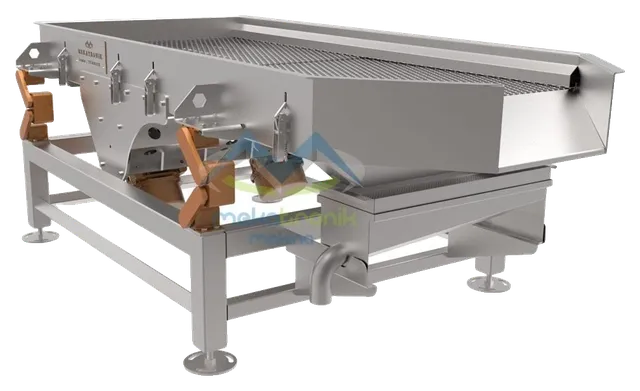
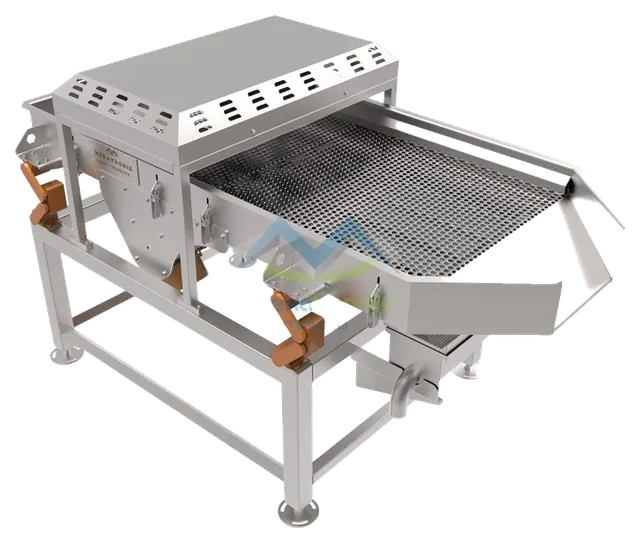
A dewatering screen belongs directly after the washer. Its job is to take the free water off the product before the next machine sees it. Placement decides whether that works: the product must arrive spread out, the water must have a clear way down, and the product must leave onto the next machine without piling up.
What the screen does at this point
The dewatering vibrating screen is placed after the washer. The mix of product and water lands on the deck. Water drains through the screen while the product travels forward over the deck under vibration. A tray under the deck collects the water and holds back fruit and debris that would block the drain.
The screen does not dry the product completely. It removes the water that runs off freely. Surface moisture that stays on the product needs another step, for example the fan-assisted dewatering screen when the next stage is sensitive to wet product.
Placement relative to the washer
Three points decide the layout.
- Washer outlet. Product leaves the washer with a lot of water. If it falls onto the screen from a height, it splashes and arrives in a heap. A short, low drop onto the feed end of the deck keeps the product spread and keeps water on the screen.
- Width. The washer outlet is often narrower than the deck. A chute that widens the stream before the deck helps the product use the whole width. This is the same feed principle described in the post on even feed across the deck width.
- Water path. The tray and drain must sit where the water can leave by gravity. Plan the drain before you fix the height of the screen, not after.
How the product leaves
At the discharge end, the product slides off the deck onto the next machine. Check these points:
- The discharge lip should be level with or slightly above the receiving machine, so product does not drop far.
- The receiving belt or feeder must be at least as wide as the discharge stream.
- Space between the screen and the next machine should be closed or guarded so product cannot fall between them.
If the next machine is a sizing stage, the product should arrive as a single layer, not a stack. The sizing vibrating screen works on two decks and separates size fractions best when the incoming layer is thin.
Common problems after a washer
- Water carried to the next machine. The deck is too short for the flow, or the product layer is too thick. Check the layer depth at mid deck.
- Drain blocked. Fruit pieces and debris reach the tray. The tray is meant to hold them back, so it needs to be emptied and cleaned regularly.
- Product bouncing and spilling at the infeed. The drop from the washer is too high or the stream is too narrow.
- Splash on the floor. Side guards are missing or the drain is undersized for the wash water.
What to check on site
- Look at the product layer at the infeed, mid deck and discharge. It should get thinner, not thicker.
- Look at the water under the deck. It should flow to the drain without standing in the tray.
- Look at the transfer to the next machine. Product should land in a steady stream, not in heaps.
- After cleaning, check that the screen dismantles and goes back together without gaps.
The page lists the screen as dismantling easily for washing, with stainless screens made for the product group and a tray that keeps debris out of the drain. The body and the product contact surfaces are AISI 304 stainless steel, with AISI 316 optional depending on the process. The drive uses two vibration motors and the power supply is 380 V / 50 Hz.
Related reading
The water side of this layout is covered in the post on handling wash water under a dewatering screen. For care of the machine over time, see the maintenance guide.