The water that leaves a dewatering screen has to go somewhere, and it carries things with it. A tray under the deck collects that water and holds back fruit pieces and debris, so the drain behind it does not block. When the tray is ignored, the first sign is water backing up under the deck.
Where the water goes
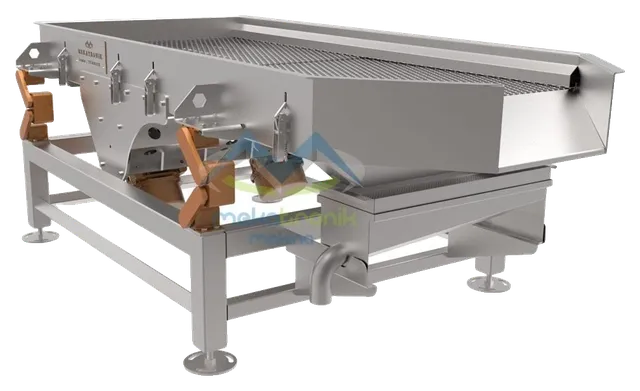
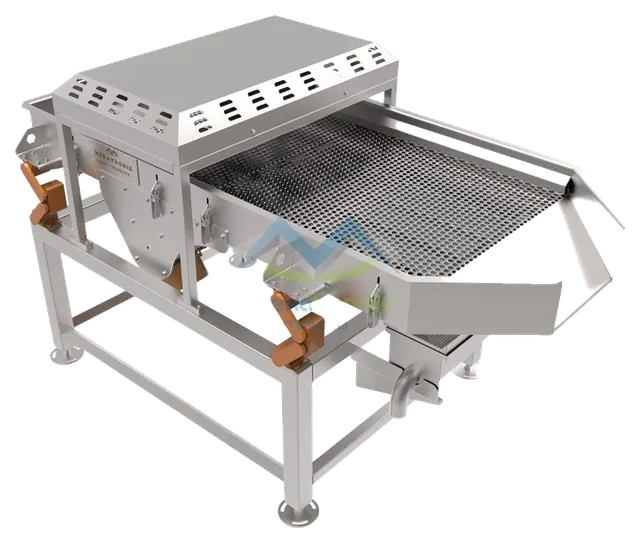
On a dewatering vibrating screen, the mix of product and water lands on the vibrating deck. The water drains through the screen while the product travels forward over the deck. The product page describes the tray under the deck as the part that collects the water and holds back fruit and debris that would block the drain.
So the water path has three stages: through the screen openings, across the tray, and out through the drain. Each stage can be blocked by something different, and each is checked in a different way.
Why debris reaches the tray
Wash water is never clean after a washer. It carries small pieces of fruit, stems, skin, sand and soft pulp that came off the product. Some pieces are smaller than the screen openings and fall through with the water. That is normal. The tray exists because of this.
If these pieces went straight into the drain, they would settle in bends and narrow sections and form a plug. A plug in a drain is slow to notice, since water simply rises a little more each hour until it stands under the deck.
What the tray does
The tray catches the falling water and holds back the fruit and debris that would block the drain. The water leaves through the drain while the debris stays on the tray, where it can be seen and removed.
A tray that holds debris in sight has an advantage over a hidden drain pipe: the person on the line can see how much is collecting and clear it before it reaches the drain.
Checks during a shift
- Look at the tray at the start of the shift. Anything left from the last shift should be gone.
- Look again during the shift, at a regular interval. Wash water from a heavier load of product brings more debris.
- Watch the water level under the deck. If it rises toward the screen, the drain is slowing down.
- Check that water leaves the tray evenly. A drain that works only from one corner may be partly blocked.
Cleaning at the end of the shift
The dewatering vibrating screen is listed with a cleaning feature: it dismantles easily for washing. This applies to the tray as well. After the shift, remove the tray debris, wash the tray, and look at the underside of the screen where sticky pulp collects. Sugar from dried fruit dries on stainless steel and turns into a film, so leaving the tray overnight makes the next day's cleaning harder.
Body and product contact surfaces are AISI 304 stainless steel, with AISI 316 optional depending on the process. Stainless is easy to wash, but only if the debris is removed before it dries.
When fans are added
Water that drains through the screen is only part of the problem. Water that stays on the product surface continues to the next stage. The fan-assisted dewatering screen adds fans over the deck, which remove surface water faster than a screen without fans. The water path under the deck still matters on that machine: the fans take off surface water, and the tray still takes the water that drains through.
Signs of a water path problem
- Water drips from the edge of the tray instead of leaving through the drain.
- The deck looks wet underneath and the product leaves wetter than it used to.
- The drain makes a gurgling sound or empties slowly after the machine stops.
- Debris from the tray appears in the drain line downstream.
Any of these means the tray and drain should be cleaned before the next run. For deeper guidance on maintenance intervals for vibrating machines, see the maintenance guide.