A vibrating screen separates well only when the product reaches the deck as a thin, even layer. If the feed arrives in a heap on one side, that side carries a thick bed that the fine pieces cannot get through, while the other side runs nearly empty and passes product it never had a chance to sort. The deck is the same, the openings are the same, and the result is worse. The cause is almost always at the feed point, not in the screen.
What an uneven feed does on the deck
Undersize can only pass when it reaches the deck surface. In a thick layer the fine pieces stay on top of the bed, are carried along with the oversize and leave at the end of the deck. They become carry-over. The guide on screening efficiency states it directly: for a given deck, higher throughput means a thicker layer and lower efficiency.
An uneven feed produces this effect locally. On a deck that is as wide as the machine, the heavily loaded strip behaves as if the machine were running over capacity, and the lightly loaded strip behaves as if it were running well under. The average throughput may be correct on paper. The separation is not.
There are three further effects:
- Panel wear is uneven. The side that sees most of the product wears first, and its openings stretch sooner than the rest.
- The deck can twist. Load on one side changes how the machine moves, and the load looks like a spring or motor fault when it is only a feed problem.
- Outlets see a lopsided flow. One side of the outlet chute fills and bridges while the other stays clear.
Where uneven feed comes from
Most feed problems have one of a few sources:
- A chute that discharges to one side. A hand-emptied container tipped into the machine lands in one spot and spreads slowly.
- A belt that delivers in surges. Product that bunches on an inclined belt arrives in waves, not a stream.
- Clumps. Sticky dried fruit arrives as lumps that fall as single large pieces and sit on the deck.
- An infeed that is narrower than the deck. The product occupies a strip down the middle and the sides stay empty.
What an even feed looks like
At the head of the deck the product should spread across the full width within a short distance and then travel forward as a layer of roughly constant thickness. On a screen with two decks the same applies to the lower deck: it only sees an even layer if the upper deck delivers one.
A simple visual check:
- Run the screen with product at normal throughput.
- Watch the first part of the deck. Is the product spread edge to edge, or is there a heap on one side?
- Look at the layer a short distance down the deck. Can you see the panel through the product in some places and not in others?
- Stop the feed and watch how the deck clears. An uneven deck clears from one side first.
How a hopper feeder evens it out
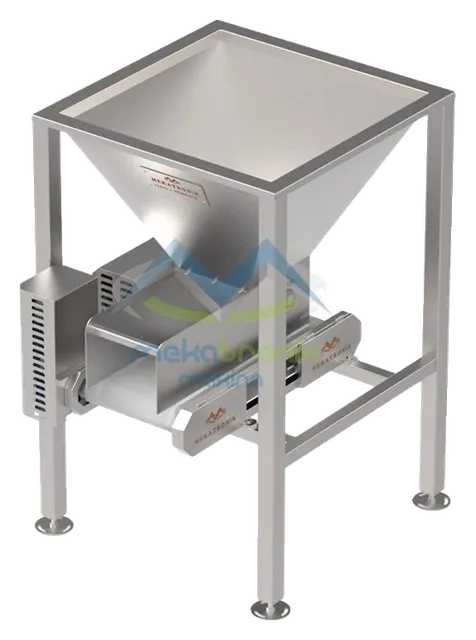
A feeder placed ahead of the screen has one job: pass the product to the next machine at an even rate. The vibratory hopper feeder takes in product emptied by hand and feeds the next machine at an even rate. Agitators in the trough help break the product up into single pieces, which also addresses the clump problem described above. Its drive is a geared motor, it can run under a PLC or stand-alone, and the construction is easy to clean. Body and product contact surfaces are AISI 304 stainless steel, with AISI 316 optional depending on the process.
The practical value is in decoupling. Operators empty a container in a few seconds. The screen needs the same product spread over minutes. A hopper with a controlled outlet absorbs the difference.
For the rate itself, the feed is matched to the screen, not the other way round. The deck has a layer thickness it can handle for the product in front of it. The feeder is set so the layer sits within that range, and the setting is checked again at each product or lot change.
Checks when the screen is already installed
If separation is poor and the panels are in good condition, check the feed before changing anything on the screen:
- Is the feed point centred on the deck width?
- Does the rate stay steady for several minutes, or does it pulse?
- Do lumps arrive at the deck?
- Is the infeed width close to the deck width?
Correcting the feed costs far less than changing panels or stroke. The maintenance guide lists the other checks that belong in the same routine, including spring and mount condition, since an uneven stroke on a machine in poor mechanical order can look much like an uneven feed.