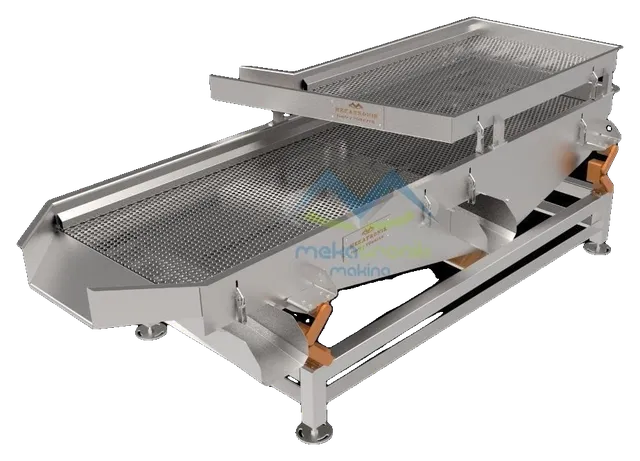
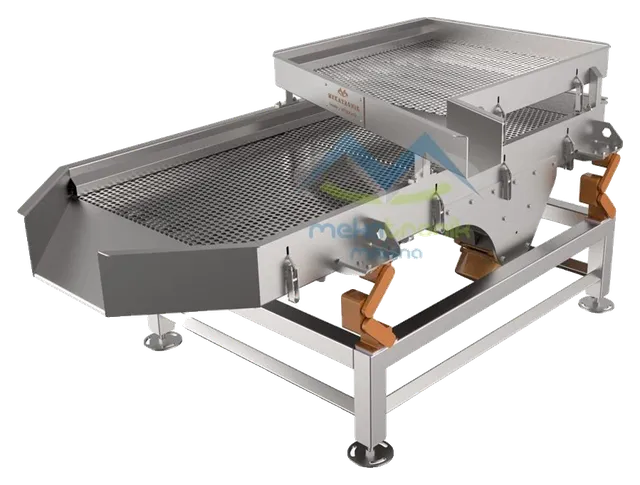
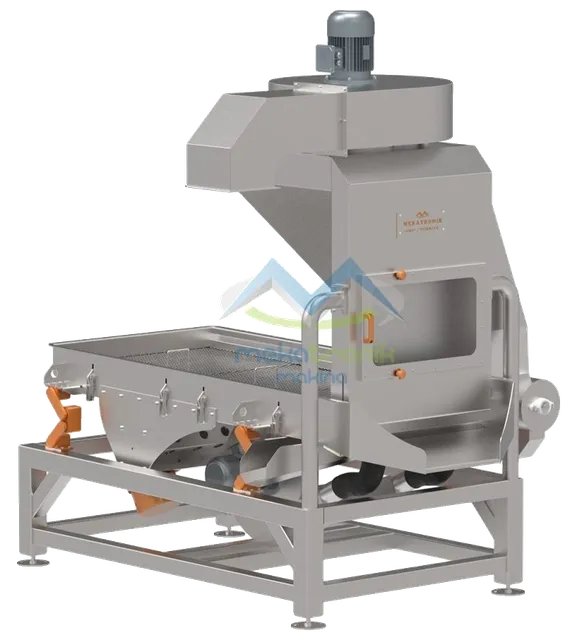
A vibrating screen with two vibration motors moves along one line. The motors turn in opposite directions, and their sideways forces cancel while their forces along the line add up. The deck pushes product forward in small hops instead of swirling it.
What a vibration motor is
A vibration motor is an electric motor with an off-centre weight on each end of the shaft. When the shaft turns, the weights swing around and shake the motor body. Bolted to a deck, the motor shakes the deck.
One motor on its own shakes the deck in a circle or an ellipse, because the force direction keeps turning with the shaft. That motion is useful for some jobs, but it does not push product in a set direction.
Why two motors turn in opposite directions
Each motor produces a force that rotates. Put two motors side by side and turn them in opposite directions. At every moment the sideways part of one force points one way and the sideways part of the other points the opposite way. They cancel. The part along the line between the two forces points the same way for both, so it adds up.
The deck therefore moves back and forth along a single line. Because that line is tilted against the deck surface, each stroke lifts the product slightly and throws it forward. The product travels over the screen openings in short hops, which gives the pieces a chance to fall through if they are small enough.
Two conditions have to hold for this to work:
- The motors turn at the same speed.
- They turn in opposite directions, and their weights are set the same.
Where the product page confirms two motors
The dewatering vibrating screen is listed with 2 vibration motors, and so is the fan-assisted dewatering screen. The two-deck sizing and impurity removal screens list vibration motors as their drive, without a number on the product page, so no count is stated here for them. Capacity is set per project on all of these machines, and the supply is 380 V / 50 Hz.
What the motion does to the product
Straight-line motion has three effects that matter on a food line.
- The product moves forward at a steady pace in a straight path. Pieces do not drift to one side of the deck.
- The hops spread the product into a thin layer. A thin layer lets small pieces reach the screen surface and drop through.
- The same motion that moves product forward also helps water drain on a dewatering deck, since each hop separates the pieces and lets water run down between them.
Compare this with circular motion, where the product is carried round and round before it moves on. How motion affects separation is covered in the screening efficiency guide.
Signs that the motors are out of step
When one motor is slower, reversed or has a shifted weight, the straight line bends. The deck starts to twist and the symptoms show up in the product first.
- Product piles up on one side of the deck, or flows faster along one edge.
- The deck seems to roll or rock instead of pushing forward.
- The product moves slowly even though the deck is shaking hard.
- One motor body runs hotter or louder than the other.
When you see one of these, check the rotation direction of each motor, then the weight setting, then the bolts that hold each motor to the frame. A reversed motor is easy to cause after maintenance work on the wiring: swapping two phases on one motor turns it the other way and changes the motion.
Mounting and bolts
The motors shake the structure all day. Mounting bolts loosen over time, so they are part of a regular check. Cables to the motors should be fixed at points that do not move with the deck, with a gentle loop where they reach the vibrating part, so they do not fatigue and break.
For general upkeep of a vibrating machine, the maintenance guide lists what to look at and how often.