Flour, spices, sugar, nuts and dried fruit all move on screws in some plants. The product decides the screw, not the other way around.
Many food factories move powders, granules and broken product on screws. A flour mill, a spice packer and a nut roaster all use them, but the screw in each plant is different: the pitch, the speed, the housing and even the way it is cleaned follow from what is in it.
This page goes through the products first, because the product is what a screw is designed around, and then the grade of steel, the housing type, capacity, hygiene and the questions a manufacturer will ask.
The machine and its parts
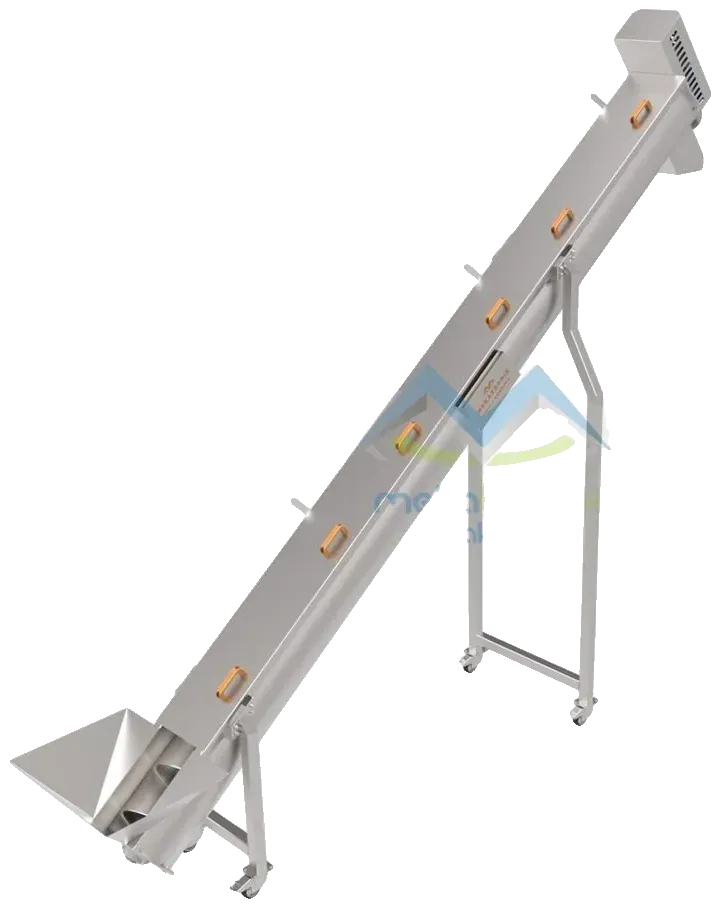
A stainless steel screw conveyor is a mechanical conveyor that moves product with a spiral or screw shaft rotating inside a stainless steel housing.
The system basically consists of the following main components:
- stainless steel housing
- screw or spiral shaft
- motor
- gearbox
- bearing system
- feed hopper
- product outlet
- protective covers
- frame and supporting structure
For the structure of the product, the screw diameter, pitch, rotating speed, motor power, housing diameter and angle of incline have to be calculated specially.
For this reason every food screw conveyor must be designed for the properties of the product it will carry.
Food products, sector by sector
Stainless steel screw conveyors can be used for a very wide range of products.
Flour and milling
In flour mills and milling systems, screw conveyor systems can be used to carry:
- flour
- semolina
- bran
- wheat
- maize
- grain products
- pulses
Carrying powder products such as flour in a closed system can reduce product loss and dust in the room.
Spice production lines
In the spice sector, stainless steel screws can be used for products such as:
- chilli flakes
- ground chilli
- cumin
- black pepper
- thyme
- turmeric
- curry
- cinnamon
- spice blends
For spices, a design that is easy to clean is important to protect the aroma of the product and to reduce cross-contamination between products.
Nut processing plants
In the nut sector, stainless steel screw conveyors can be used for conveying and feeding products such as:
- hazelnuts
- almonds
- peanuts
- pistachios
- walnut pieces
- sunflower seeds
- pumpkin seeds
To reduce product breakage, low-speed systems with a suitable screw pitch can be preferred.
Dried-fruit processing lines
Stainless steel screw systems can be used at several points in the dried-fruit sector.
For example, for the conveying, feeding and dosing of products such as:
- raisins
- dried apricots
- dried figs
- dates
- dried plums
- dried tomatoes
- broken dried fruit
- diced dried fruit
Because dried fruit is delicate, the screw has to be designed so that it does not damage the product.
Sugar and confectionery
In sugar production and packing plants, the following can be carried with stainless steel screws:
- granulated sugar
- crystal sugar
- icing sugar
- confectionery raw materials
- cocoa-based mixes
For powder products, a fully closed housing is an advantage for hygiene and dust control.
Coffee and cocoa production
In the coffee sector, food-grade screw systems can be used for products such as:
- coffee beans
- ground coffee
- cocoa powder
- cocoa pieces
For ground products in particular, it is important that the system can be dismantled and cleaned easily.
Milk powder and food powders
In plants that make food powders, products such as:
- milk powder
- protein powder
- whey powder
- starch
- cocoa
- flour
- instant drink mixes
can be carried by stainless steel screw conveyor systems.
In such applications the closed housing, the sealing and the design details that stop the product from caking become important.
Prepared food, sauces and semi-fluid products
Special screw designs can also be used for some semi-fluid products such as:
- dough
- purée
- fruit pulp
- vegetable pieces
- thick-consistency products
- meat and food mixes
In these applications, special flight shapes and open-channel designs can be used instead of a standard screw.
AISI 304
AISI 304 stainless steel is among the most widely used types of stainless steel in the food sector.
Its advantages can be listed as:
- corrosion resistance
- a hygienic surface
- ease of cleaning
- suitability for contact with food
- mechanical strength
- long service life
For most dry products and standard food conveying applications, a screw in grade 304 stainless steel can be sufficient.
AISI 316
Under more aggressive working conditions an AISI 316 stainless steel screw can be preferred.
AISI 316 can give higher corrosion resistance in applications such as:
- products with a high salt content
- acidic foods
- plants with intensive washing
- lines that use chemical cleaning
- seafood
- brined products
When the material is chosen, the chemical composition of the product and the cleaning procedure should be considered, not only the price.
Horizontal screws
Horizontal screws are used to carry the product between two points at the same level.
This is one of the most common applications.
For example, a horizontal screw can carry product from the outlet of one machine to the inlet of another, from a hopper to a packing system, or from a storage area to a production line.
In horizontal systems, energy consumption and product movement are generally more controlled.
Inclined screws
When the product has to be carried between different heights, an inclined screw conveyor can be used.
As the incline increases, however, the effective capacity of the screw can fall.
For this reason the following are calculated together in the design:
- product density
- how slippery the product is
- screw diameter
- screw speed
- angle of incline
- screw pitch
Vertical screw conveyor
With some products, near-vertical conveying is possible.
Not every product is suitable for a vertical screw system, however.
A vertical screw design may need a high speed, a special spiral geometry and a correct feeding system.
For this reason a product test is important in vertical conveying applications.
Working out the capacity
The capacity of a screw conveyor does not depend on the screw diameter alone.
The following are considered in the capacity calculation:
- screw diameter
- screw pitch
- rotating speed
- density of the product
- fill ratio
- incline of the conveyor
- friction coefficient of the product
- grain size of the product
The same screw system can give completely different capacities with two different products.
For example, flour and raisins do not give the same kg per hour in the same system.
The product information must therefore always be obtained before the price or the capacity of a stainless steel screw is set.
Hygienic design
Hygiene is one of the most important subjects in food machines.
In a well-designed hygienic screw conveyor system the following criteria are considered:
- dead spots where product can collect are kept to a minimum
- sharp inside corners are reduced
- weld surfaces are smooth
- there are cleaning covers
- the screw can be removed easily
- the inside of the housing can be cleaned with ease
- parts that touch the product are made of material suitable for food
- a suitable surface quality is achieved
In a food plant, stainless steel alone does not make a design hygienic.
What matters most is that the system is designed so that it can be cleaned.
Closed housings
For powders and small granular products, using a closed screw is an important advantage.
A closed system can:
- reduce dust in the room
- prevent product loss
- protect the product from the outside environment
- help keep the production area cleaner
For this reason closed-housing screw conveyors are often preferred for flour, sugar, spices and powdered food products.
Open channels
Open-channel screw systems can be preferred where easy cleaning is needed or for products in large pieces.
A top cover that can be opened makes access to the screw and the housing easier.
This system can help in plants where the product is changed often.
Adding a hopper
A stainless steel hopper or feed bin can be added to a stainless steel screw conveyor to feed product into it.
Hopper systems feed the product to the screw in an orderly and controlled way.
Screw systems with a hopper are often used on packing machines, weighing systems and production lines.
Using a screw for dosing
A screw is not used only for conveying.
With a correct design and an inverter-controlled motor system it can also be used as a dosing screw.
For example, a set amount of:
- flour
- spices
- sugar
- powder product
- granule product
can be fed into the production line.
With PLC and inverter-controlled systems the product feed rate can be set precisely.
Motor and gearbox
The choice of motor and gearbox has a direct effect on the service life of a screw system.
When the motor power is set, the following have to be calculated:
- screw length
- screw diameter
- amount of product carried
- product density
- incline
- starting load
An undersized motor can lead to the motor working under overload.
An oversized motor causes needless energy consumption and investment cost.
The right motor and gearbox should therefore be chosen by engineering calculation.
Welding
Weld quality is very important on machines used in the food sector.
Suitable welding methods must be used on stainless steel housings.
Where needed, TIG welding can be preferred to obtain a smooth and hygienic surface.
After welding, the spatter has to be cleaned off and the areas that touch the product must have a smooth surface.
What to tell the manufacturer
Before buying a stainless steel screw, the following information should be given to the manufacturer:
- What is the product to be carried?
- What capacity is wanted, in kg per hour or tonnes per hour?
- What is the length of the conveyor?
- How many metres will the product be lifted?
- Will it run horizontally or on an incline?
- What is the temperature of the product?
- Is the product damp or dry?
- Is the product sensitive to breaking?
- Is AISI 304 or AISI 316 needed?
- What will feed the machine?
- Which machine will the product be passed to?
- How will the cleaning system work?
When this information is set correctly, a stainless steel screw conveyor can be designed that is both more efficient and longer lasting.
In practice
That is the whole of the argument: a food screw is specified from the product, the capacity and the cleaning method, and everything else on the machine follows from those three. The contact page names the manufacturer referenced on this site.