The springs and mounts under a vibrating screen do two jobs. They let the deck move freely so the vibration motors can drive it, and they keep that movement from passing into the floor and the structure. When one fails, the deck changes how it moves, and the symptoms show up in the product stream before anyone looks underneath. A routine check of the mounts costs little and catches the problem early.
What the mounts are for
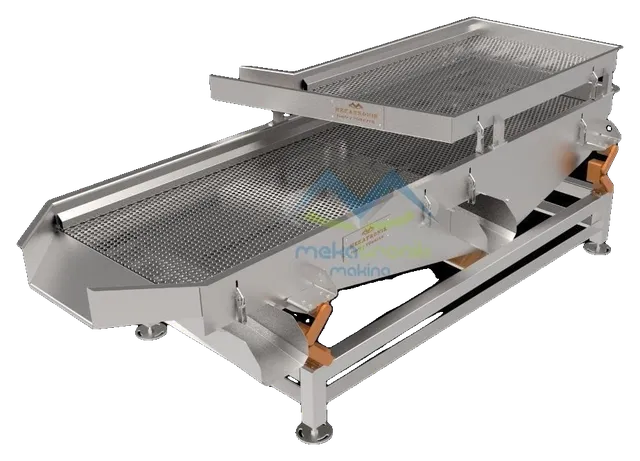
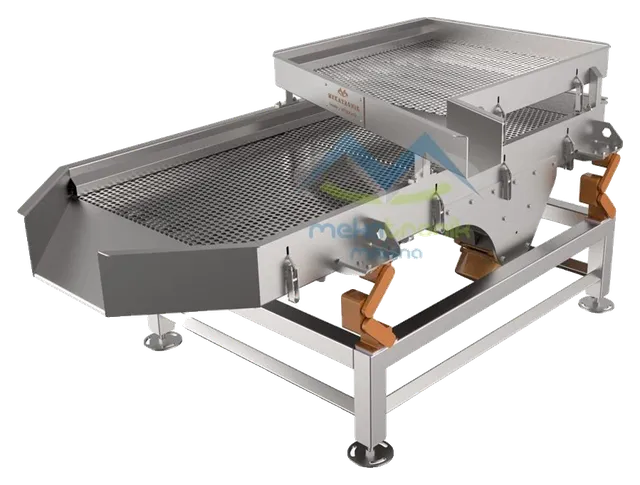
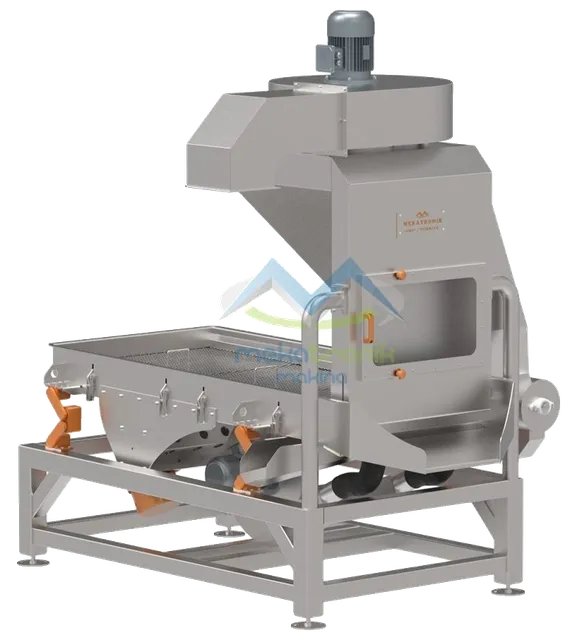
A vibrating screen is a deck on a frame, driven by vibration motors and supported on elastic elements. The elements are coil springs, leaf springs or rubber isolators, depending on the machine. The motors set the deck moving, and the supports allow the motion while carrying the weight.
If the supports are healthy, the deck follows the stroke it was set up for. If one corner sags or one mount hardens, the stroke changes on that side. The product no longer travels at the same speed across the width of the deck, so one edge moves faster than the other and the layer becomes uneven. That is why a worn support looks like a feed problem or a panel problem at first.
Coil and leaf springs
Look for these on each spring:
- Cracks, especially near the ends where the spring meets its seat and where stress concentrates.
- Sagging. Compare the height of springs of the same type on the same machine. A spring that sits lower than its neighbours has lost its stiffness.
- Corrosion on the surface, which can start a crack. On a machine washed down regularly, check the seats where water collects.
- Seat condition. A worn or loose seat lets the spring move sideways, which adds a second, unwanted motion.
A broken spring changes the stroke on one side and twists the deck. A spring with a crack that has not yet failed is the reason to look regularly, since the crack is often visible before the machine behaves differently.
Rubber mounts and isolators
Rubber ages. It hardens with time, with heat and with some cleaning chemicals, and it can split. Look for:
- Hardening: the rubber feels stiff and no longer gives under hand pressure.
- Splits, tears or flattened sections.
- Separation between rubber and metal at the bonded surface.
- Swelling or softening, which can point to contact with oil or an unsuitable cleaning agent.
A hardened mount passes vibration into the floor. If a nearby machine or the building starts to hum, the isolators under the screen are one of the first things to inspect.
Compare both sides
The quickest method that needs no instruments is comparison. A machine with two vibration motors and symmetric supports should move the same way on the left and the right.
- Run the machine empty.
- Watch the deck edge on each side. The motion should look the same.
- With the machine stopped and locked out, compare the height of the springs side to side.
- Compare the stroke at each end of the deck, feed end and discharge end.
A difference between sides points to a spring, a loose mount or a motor fault on one side. The maintenance guide lists the same check, along with the motors, fasteners and panels that belong in the same inspection.
Signs in the product
Faults in the supports often show up in the product before they are found underneath:
| What you see | Likely cause |
|---|---|
| Product moves slowly or stops on one side | Broken spring, loose mount, or motor fault on one side |
| Deck twists or rocks | Spring failure or cracked support |
| New knocking noise | Loose fastener, worn seat or bearing |
| More undersize in the oversize stream | Uneven stroke that thickens the layer on one side |
The last row matters because separation faults are usually blamed on panels. The article on screening efficiency explains how stroke and layer thickness set the result, so a spring that alters the stroke is a direct cause of poorer separation. The sizing vibrating screen page lists the two stainless decks whose motion depends on these supports.
Related damage
Springs that no longer do their job pass the load into the structure. Check these near the supports:
- Welds at the deck supports and the motor mounts, for cracks.
- Bolted joints, which vibration loosens over time.
- Cables and glands near the machine, for chafing.
When to replace
Replace springs that are cracked or have visibly sagged, and rubber mounts that are hardened or split. Replace matching elements together on the same side, since a new element next to an old one gives an uneven result, and keep the same type. Different stiffness on two corners twists the deck as surely as a broken spring does.
After any replacement, run the machine empty and repeat the side-to-side comparison before product goes back on the deck.