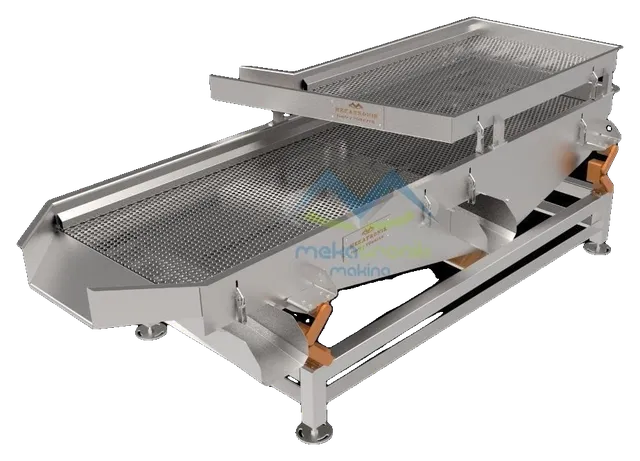
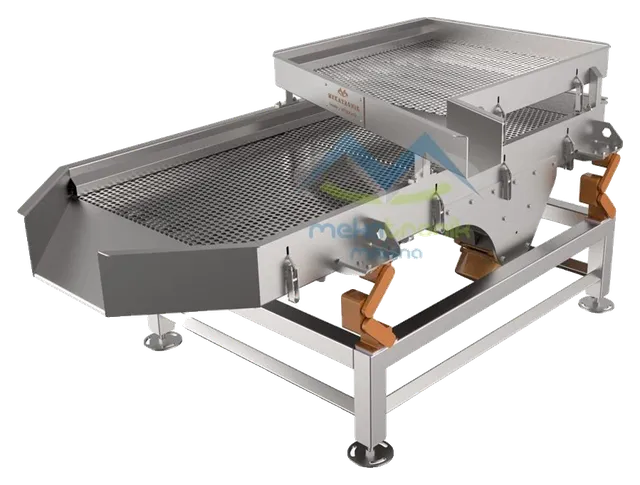
Raisins are sized on a two-deck vibrating screen by stacking the coarser opening above the finer one. The top deck passes everything except the largest pieces and the coarse debris, the lower deck splits the remaining product, and each fraction leaves through its own outlet. The deck order is not a matter of taste. A piece can only fall downward through an opening, so the screen has to be arranged from coarse to fine.
What happens on each deck
Product is fed onto the top deck and travels forward under vibration. On the sizing vibrating screen, pieces that are small enough drop to the lower deck while coarse debris stays on top and is carried to the end. The lower deck then separates the rest by size. Two decks give three streams:
- Material carried off the end of the top deck: the largest pieces and coarse debris.
- Material carried off the end of the lower deck: the middle fraction.
- Material that falls through the lower deck: the smallest fraction.
Which grade ends up in which stream depends on the opening sizes chosen for the panels. The panels are made for the product group, so the opening sizes are set from the grades the plant wants at the outlets, not taken from a standard list.
Why the coarse deck goes on top
If the finer deck were on top, the largest raisins would sit on a surface that cannot pass them, and the coarse debris would blind the openings. The finer panel would carry the whole load of the incoming stream. With the coarse deck first, it takes the first cut and protects the finer deck below it. The lower deck then works on a narrower range of sizes, and a narrower range separates more cleanly because fewer pieces sit close to the opening size.
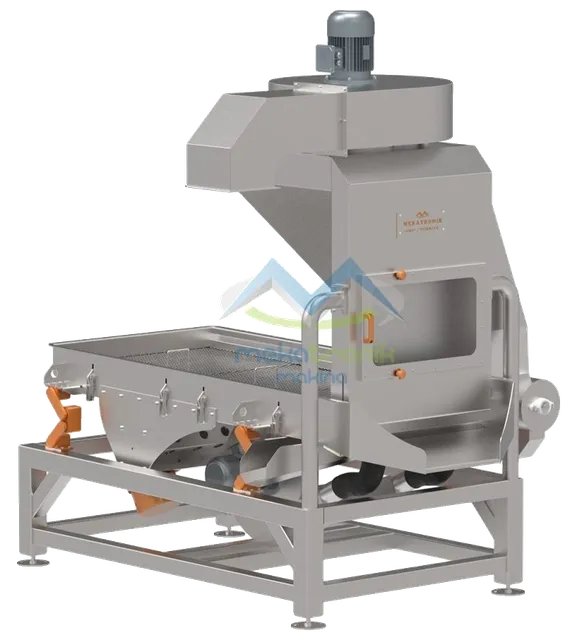
This is also the reason a separate debris stage ahead of the sizing line is sometimes worthwhile. A machine such as the impurity removal screen takes coarse material out before the product reaches the sizing stage, so the sizing decks only see raisins.
Raisins behave differently from hard products
Raisins are soft and can be sticky, and their shape is irregular. Three things follow from that.
First, pieces near the opening size do not pass on the first contact. A raisin that is longer than it is wide may pass end-first or stay on top depending on how it lands. Screens for dried fruit are therefore judged on how the grades look at the outlets, not on a single cut size.
Second, sticky product clings to the panel and to other pieces. Clumps behave as one large piece and ride over the openings. If clumps arrive at the screen, they end up in the coarse fraction regardless of the size of the individual raisins. Breaking clumps up ahead of the screen keeps them out of the wrong grade.
Third, the surface of the product varies with the lot and the season. Settings that suit one lot may need a small change for the next. The guide on screening efficiency lists the factors that move the result: opening size and shape, layer thickness, deck angle, stroke and product condition.
Outlets
Each size fraction leaves the machine through its own wide outlet chute. Width matters because raisins bridge across a narrow chute and stop flowing, and then the deck backs up. A wide chute lets the fraction drop out freely and keeps the layer on the deck thin and even.
A practical check at the outlets is to look at what each stream actually contains:
- Take a handful from each outlet during steady running.
- Spread it on a tray and look for pieces that belong in the neighbouring grade.
- Look at the coarse stream for small raisins carried over. A lot of them points to a layer that is too thick or panels that are blinded.
- Look at the fine stream for large raisins. They suggest worn or stretched openings.
Do the same check after each product or lot change. A change in the mix at an outlet is the earliest sign that something in the screen has shifted.
Matching the machine to the line
The product list on the sizing screen page names raisins along with dried apricots, figs and dates. The standard equipment is two stainless decks and a wide outlet chute for each size fraction. The body and product contact surfaces are AISI 304 stainless steel, with AISI 316 optional depending on the process. Capacity is set per project, and dimensions are made to suit the installation.
When the line is being planned, the order of questions is:
- Which grades are needed at the outlets, and how many?
- Does the product arrive with debris that should be removed in the same pass or beforehand?
- Is the feed even across the width of the deck?
- Where do the three streams go next: packing, further processing or return?
Two decks cover three streams. If the plant wants more grades than that, a second sizing machine in series is the usual route. The page on sizing and selection goes through how the number of decks and the openings follow from the sizes required.
Keeping the grades stable
Once the openings are set, the grades stay stable only as long as the panels do. Stretched or worn openings let larger pieces through, and blinded openings reduce the open area so the fine fraction ends up in the coarse stream. Inspect and clean the panels at each product change and at wash-down, and keep the feed rate steady. A variable feed changes the layer thickness, and layer thickness changes the cut.