Blinding means the screen openings are covered or filled by sticky material. Pegging means a piece of product is stuck in an opening, partly through. Both reduce the open area of the screen, so less product falls through and more rides to the end of the deck.
Telling the two apart
The two problems look similar from a distance, because in both cases the screen passes less product. Up close they differ.
- Blinding: a film or a layer of sticky residue spreads over the screen surface and across the openings. Fruit sugar, pulp and dust bind together and close the openings from above.
- Pegging: individual pieces lodge in individual openings. A piece slightly larger than the opening, or one that has a thin end, enters the opening and wedges there.
The cure depends on which one it is, so the first check is to look at the deck and run a finger over a few openings with the machine stopped.
Why dried fruit does this
Dried fruit carries sugar on its surface. Raisins, figs, apricots and dates are all sticky to some degree, and the stickiness changes with temperature and humidity. A warm, humid room makes the surface tackier. Product that arrives from a washer carries moisture, and moisture turns sugar into syrup that coats the screen.
Fruit that has just been cut, or that has soft flesh exposed, leaves more residue. Fine dust and broken skin mix with the sugar and form a paste. This paste builds up on the screen in a thin layer, usually starting at the feed end where the product is wettest.
Causes on the machine side
- Opening size close to product size. When a large share of the product is nearly the size of the opening, many pieces enter the opening but do not pass. This is the main cause of pegging and is set when the screen is chosen. The sizing selection guide explains how openings are matched to product.
- Overloaded deck. A thick bed keeps pieces from moving freely, so they press into the openings instead of tumbling across them.
- Weak vibration. The motion is what shakes pieces out of the openings. If the motors or their mounts have lost strength, pegging grows.
- Uneven feed. A feed that arrives in lumps loads one part of the deck and leaves the rest empty.
Checks
- Stop the machine and look at the screen surface under good light.
- Check whether the problem sits at the feed end, the middle or the discharge end of the deck. Blinding from wet product starts at the feed end. Pegging usually spreads wherever the product size is near the opening size.
- Look at the product on the deck while the machine runs. A thick bed that does not move points to overload or weak vibration.
- Check the feed. A continuous, even stream is the target; see how the vibratory hopper feeder passes product to the next stage at an even rate.
What helps
For blinding, cleaning is the main answer. Stainless screens can be washed, and the sizing screen page lists stainless screens made for the product group. Wash the screen at the end of the shift while the residue is still soft, because dried sugar needs much more effort.
For pegging, the screen opening may have to change. A different opening shape or size often removes the problem, since the stuck piece fits the opening only slightly. Pegging that does not clear with cleaning is a selection problem, not a maintenance problem.
For both, an even feed and a thin product bed help. A thin bed gives each piece room to move, and moving pieces knock others out of the openings.
Where this happens in the line
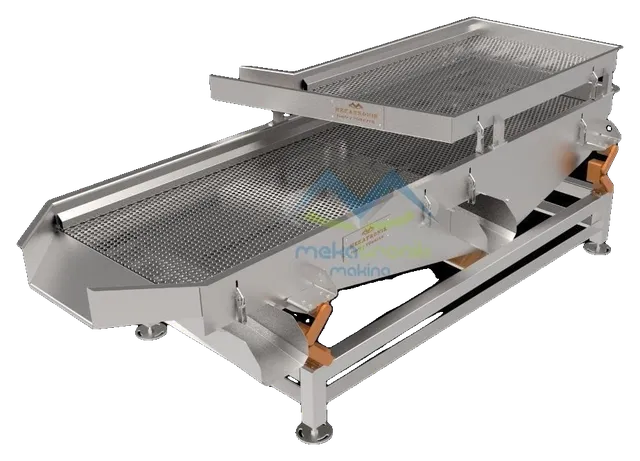
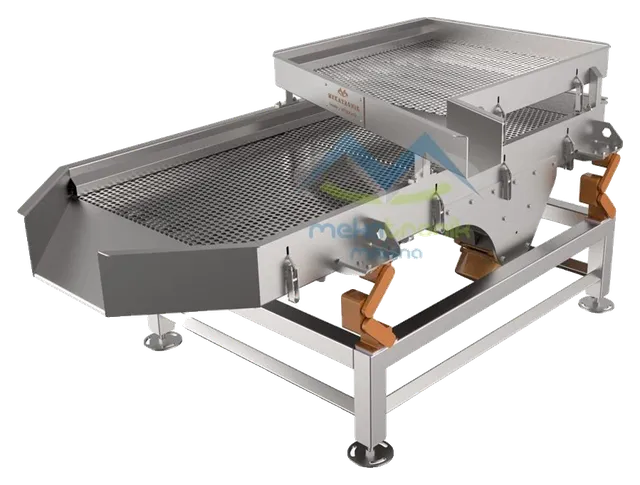
On the sizing vibrating screen, product moves over two stainless decks and each size fraction leaves through its own outlet. If the upper deck pegs, the fraction taken off at the lower deck changes, so the sizing result drifts without any alarm. For that reason deck cleanliness belongs in the shift checklist next to the motor and bolt checks in the maintenance guide.