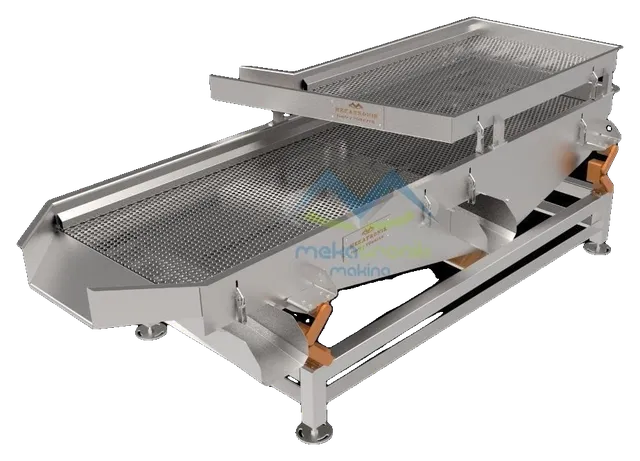
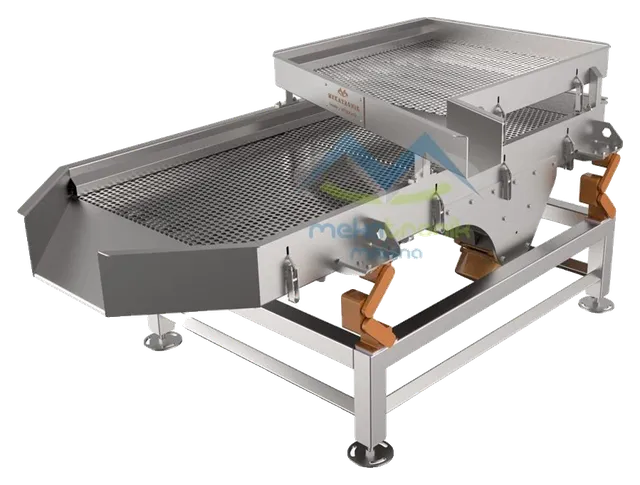
The path the deck follows decides how the product travels. Straight-line motion pushes product forward in a controlled hop. Circular motion moves it in a loop and relies on the slope of the deck to carry it along.
Circular motion
In a circular motion screen every point on the deck traces a circle. The product is lifted, thrown slightly forward and dropped again. Because the motion has no forward direction of its own, the deck is usually tilted so gravity moves the material toward the discharge.
This works for loose, free-flowing material. The tilt brings a disadvantage: the machine stands higher at one end, which affects the way it is fed and how its outlets are placed.
Linear motion
In a linear motion screen the deck moves back and forth along a straight line set at an angle to the deck surface. Each stroke pushes the product up and forward. The deck itself can be level or nearly level, because the motion carries the product along.
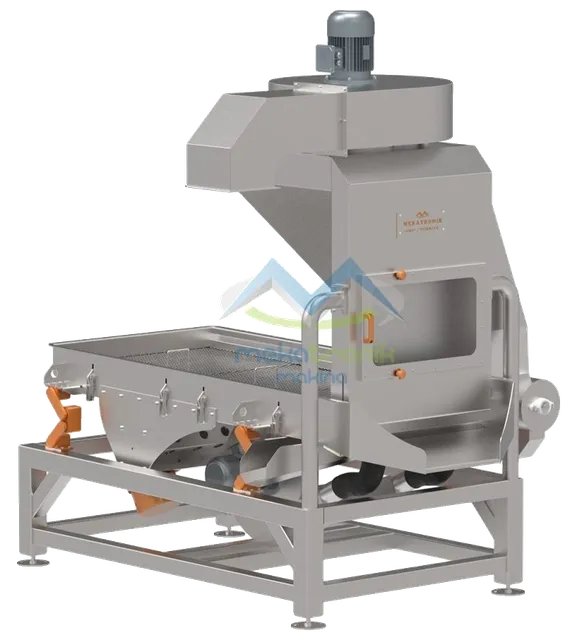
Two vibration motors turning in opposite directions produce this straight line. The sideways forces of the two motors cancel each other, and the forces along the working line add up. Several machines on this site are driven by two vibration motors, for example the vibrating screen with aspiration. The motor setup of a given machine is stated in its specification table.
What changes for the product
Travel on the deck. Linear motion moves product forward in a regular pattern. The bed stays thin and even, and pieces get repeated chances to meet a screen opening.
Sticky and clustered fruit. Dried apricots, figs and raisins can cling to each other. A forward hop spreads the layer and separates pieces. A circular loop tends to keep the pile together longer.
Light debris. On a machine that combines screening with air flow, a thin and even layer exposes debris to the air. The motion therefore affects how well aspiration works. See the post on aspiration for light foreign material.
Residence time. The same product spends a different time on the deck under each motion. Time on the deck sets how many chances a piece has to pass through an opening. This is one of the main points in the guide on screening efficiency.
Effects on the machine
The motion type also changes the structure:
- Circular machines need a tilted frame and bearings that handle a rotating load.
- Linear machines with two motors can use a level, compact frame, but the two motors have to stay in step, and the mounts must stay in good condition.
- Either type passes vibration to the floor. Springs or rubber mounts and a firm support are part of the design.
Choosing for dried fruit lines
For a food line the question is less about the motion in the abstract and more about the product:
- Is the product free-flowing or does it clump? Clumping favors a motion that moves it forward in a thin bed.
- How many fractions must be taken off? A sizing vibrating screen grades product into size fractions on two stainless decks, and each fraction leaves through its own wide outlet. A level installation makes the outlets easier to place.
- How much headroom and floor space does the line have?
- How will the machine be cleaned? Fewer parts and open access matter more than the motion type.
Checks in service
Motion problems show up as changes in product travel. If product moves toward one side of the deck, or piles at the feed end, look at:
- the vibration motors, for equal running and secure fixing;
- the mounts, for cracks, sag or loss of springing;
- the screen panel, for slack or damage;
- the feed, for a stream concentrated at one side.
The maintenance guide lists these checks and the order in which to make them.