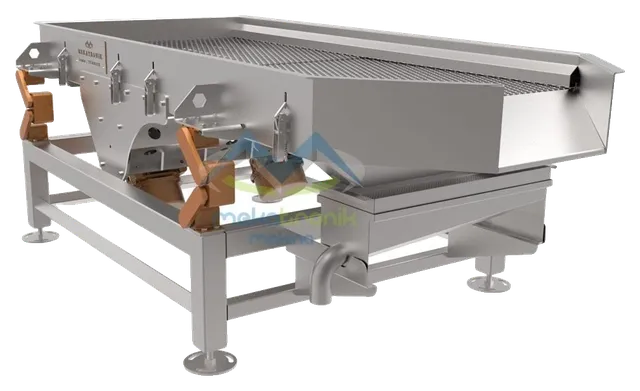
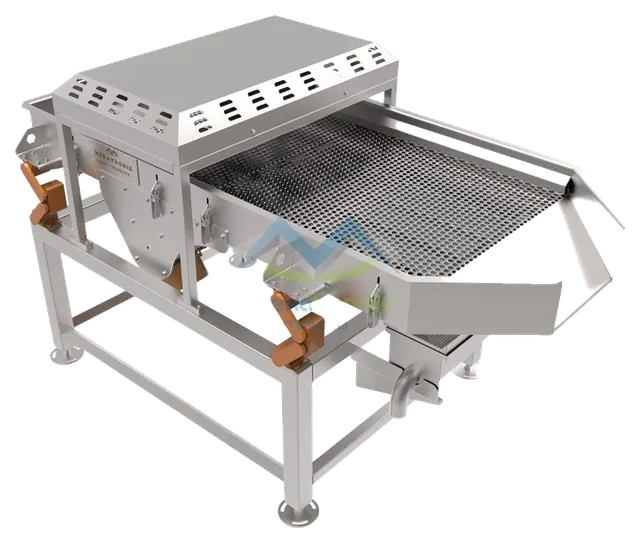
A plain dewatering screen removes the water that runs off the product. A fan-assisted screen also removes the thin film that stays on the surface of each piece. Whether that second step is needed depends on what the next machine does with wet fruit.
What drainage alone leaves behind
On a dewatering vibrating screen the mix of product and wash water lands on the deck. Water drains through the screen while vibration moves the product forward. Free water leaves quickly. Water that clings to the skin of the fruit does not, because surface tension holds it in place. Dried fruit with a sticky or wrinkled skin holds more of it, and pieces that touch each other keep small pockets of water between them.
The product that leaves the deck is therefore drained, but still wet at the surface. For many lines this is acceptable. For others it causes problems in the next stage.
What fans change
A fan-assisted dewatering screen keeps the same basic action: product and water are separated on the vibrating screen. Fans are mounted over the deck and blow across the product as it travels. The air breaks the surface film and carries off the remaining water. The product reaches the end of the deck drier than it would on a screen without fans.
The standard equipment on this machine is the fan drying system and stainless screens made for the product group. The body and product contact surfaces are AISI 304 stainless steel, with AISI 316 available depending on the process. The power supply is 380 V / 50 Hz.
Questions that decide it
What comes next? Look at the machine after the dewatering screen. Some stages tolerate surface water. Others do not:
- A sizing screen with fine openings can blind when wet pieces stick to the panel.
- A hopper or conveyor that receives wet fruit can build up a sticky layer that needs frequent cleaning.
- Packing or a dryer further down the line may be sensitive to added water.
If the next stage is sensitive, fans are worth considering. If the next stage is a dryer that is built to take wet product, the extra step may add nothing.
How wet is the product on arrival? Fruit that comes straight from a washer carries more water than fruit that has already passed through a spin or air knife. Heavy washing, a soak stage or a rinse that stays on the skin all raise the load on the deck.
How sticky is the product? Raisins and dates behave differently from firm fruit. A sticky product holds water longer, and its pieces cling to each other. Air over the deck helps separate them as well as dry them. The fan-assisted screen is listed for dates on its machine page.
What can the building take? Fans move air, and that air carries fine mist and sometimes light debris. The extra air flow has to be accounted for when the machine is placed near other equipment.
Where the water goes
The fans do not change the drain. Water that passes through the screen still has to be collected below the deck and led away. The tray under the deck must hold back fruit pieces and debris that would block the drain. This is covered in more detail in the article on dewatering after washing.
Capacity and sizing
The capacity of a fan-assisted screen is set per project. It depends on the product, the incoming water load and the target dryness, so it is worked out with the line in front of you rather than read from a table. Dimensions are made to suit the installation.
Checks after commissioning
Once the machine runs, look at the product at the discharge end rather than at the deck:
- Pick up a handful and check whether pieces stick together.
- Look at the next machine for wet residue on its first panel or chute.
- Watch whether water collects at the discharge lip.
If the product is still wet at the surface, the fix may be the feed rate, the amount of product on the deck or the fan setting, not a larger machine. A thick layer shields the pieces underneath from the air.
Cleaning
The machine dismantles easily for washing. This matters because a screen that handles wet fruit and moving air collects residue faster than a dry one. Plan the cleaning access when choosing the position of the machine. The maintenance guide lists what to inspect on a regular basis.