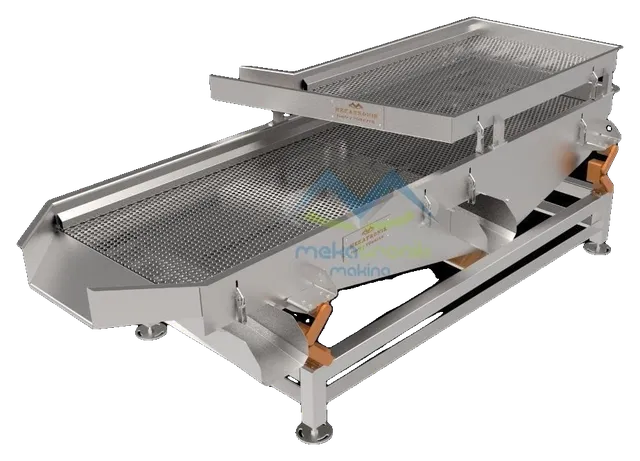
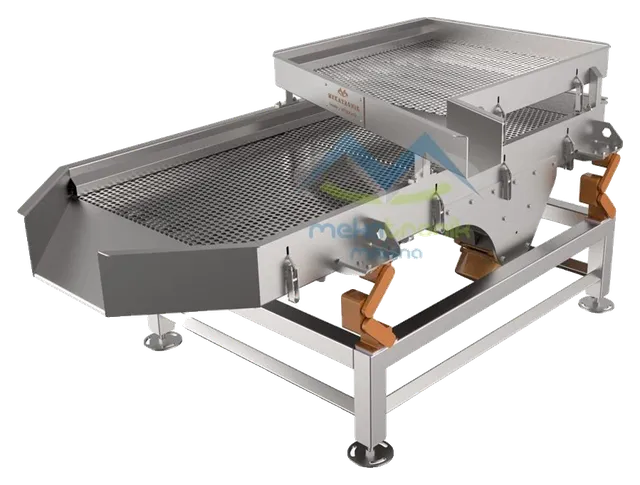
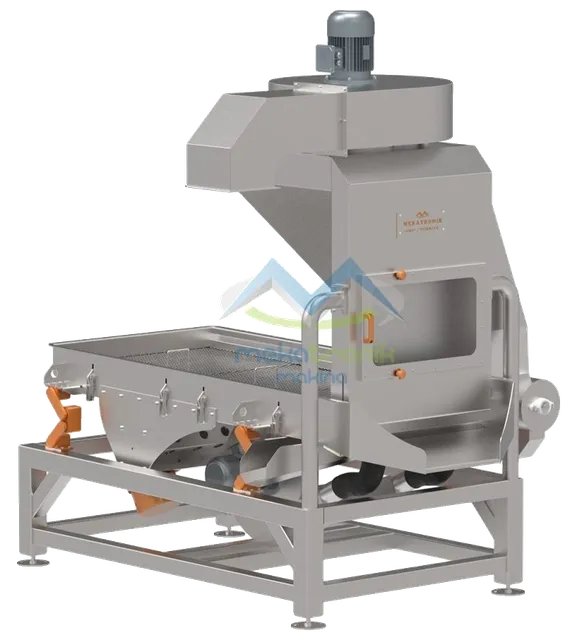
A double-deck vibrating screen has two screen surfaces mounted one above the other in the same vibrating body. The product is fed onto the top deck; whatever is too large for the top deck openings travels over it, the rest falls to the lower deck, and the lower deck splits that again. One machine therefore gives three streams: over the top deck, over the lower deck, and through the lower deck.
Why two decks instead of two machines
Two single-deck screens in series do the same separation, but they need two bodies, two drives, a transfer between them and twice the floor space. In a double-deck screen both separations happen in one pass, with one set of vibration motors moving both decks together.
The two decks also share the work. The top deck takes the largest material out first, so the lower deck, which has the finer openings, only sees product that can actually pass through it or be sized on it. A fine screen panel loaded with coarse material wears faster and screens worse.
What the top deck does
In dried-fruit lines the top deck usually has one of two jobs, depending on the machine:
- Holding back coarse debris. Stems, sticks, pieces of packaging and stones larger than the fruit stay on top and leave through their own outlet. The fruit passes through.
- Taking off the largest size fraction. When the machine is used for sizing, the top deck openings are set at the boundary between the largest grade and the next one.
On the sizing vibrating screen both happen together: while the product is graded on two stainless decks, coarse debris is held back on the top deck.
What the lower deck does
Everything that passed the top deck lands on the lower deck. Its openings set the next boundary. Product that stays on the lower deck is one fraction; product that passes through it is the smallest fraction, or fines and small debris, depending on the line.
Each stream leaves the machine through its own wide outlet chute. Wide outlets matter on dried fruit: sticky product bridges in narrow chutes and the fraction backs up onto the deck.
Choosing the screen panels
The screen panels are stainless and made for the product group. A deck for raisins is different from a deck for dried apricots or dried figs, because the size, shape and stickiness of the product differ. Three properties are set for each deck:
| Property | What it decides |
|---|---|
| Opening size | The boundary between the fractions |
| Opening shape | How elongated or flat pieces are sorted |
| Open area | How quickly the product can pass the deck |
Round openings sort by the smallest cross-section that fits. Slotted openings let long, thin pieces through that a round hole would hold back. The choice depends on what the next stage needs: an even grade for packing, or clean fruit with debris removed.
Feeding the top deck
A double-deck screen only separates well if the product is spread across the full width of the top deck. A narrow, heavy stream in the middle overloads part of the deck, the product rides over the openings without touching them, and pieces that should pass end up in the wrong fraction.
Feeding from a vibratory hopper feeder gives an even rate. Agitators in its trough help separate clumped fruit, so the screen receives single pieces rather than lumps.
Double deck for cleaning only
Not every two-deck machine is used for sizing. The impurity removal screen uses two decks to take coarse debris out of incoming product before sorting or washing. Here the decks are chosen to keep the fruit together as one stream and remove what does not belong in it.
What to check in operation
- Product in the wrong outlet. Check the screen panels for wear or a damaged opening, and check that the feed is spread across the width.
- Product building up at the outlet. The chute is blocked or the next machine is not taking the product away fast enough.
- Openings closing up. Sticky fruit and fines can block openings over a shift. The panels should come out easily for cleaning.
- A deck that does not move product forward evenly. Check the vibration motors and their mounting bolts.
The maintenance guide covers the routine checks on vibrating screens in more detail, and sizing and selection explains how the deck size is matched to the product flow.